A pre qualification questionnaire (PQQ) is the set of questions a buyer uses to decide whether a supplier is capable enough to be invited to bid or to be considered at all. You may also see it called a selection questionnaire (SQ). The Procurement Act 2023 no longer prescribes a standard questionnaire, so what you are asked now depends on the conditions of participation in each notice.
Checked against official guidance on 23 October 2026. Tenderpatch is not a legal adviser: always rely on the official notice and documents before you bid.
In this guide
What a pre qualification questionnaire is
Under the older procurement rules, buyers often issued a pre qualification questionnaire, or a standard selection questionnaire, before inviting the best-qualified suppliers to tender. It asked for company information, financial standing, relevant experience and declarations about grounds for exclusion. Documents with these names still circulate, and some buyers still use their own versions.
What the Procurement Act says now
The Cabinet Office’s conditions of participation guidance says the Act does not prescribe how suppliers must demonstrate compliance and does not require the Single Procurement Document or the standard selection questionnaire used under previous regulations. Buyers can still use templates if they comply with the Act, and for works, industry pre-qualification tools can be used if they comply.
The main concepts are:
- Conditions of participation. These can relate only to legal and financial capacity or technical ability to perform the contract and must be proportionate. They are set out in the tender notice.
- Core supplier information. Suppliers must confirm up-to-date information on the central digital platform, covering basic details, exclusion grounds, economic and financial standing and connected persons.
- Other information. Condition-related information not held on the platform is collected by the buyer, for example through its own tender system.
The GOV.UK short guide for suppliers says core business details are stored for reuse across bids, so you do not retype them each time.
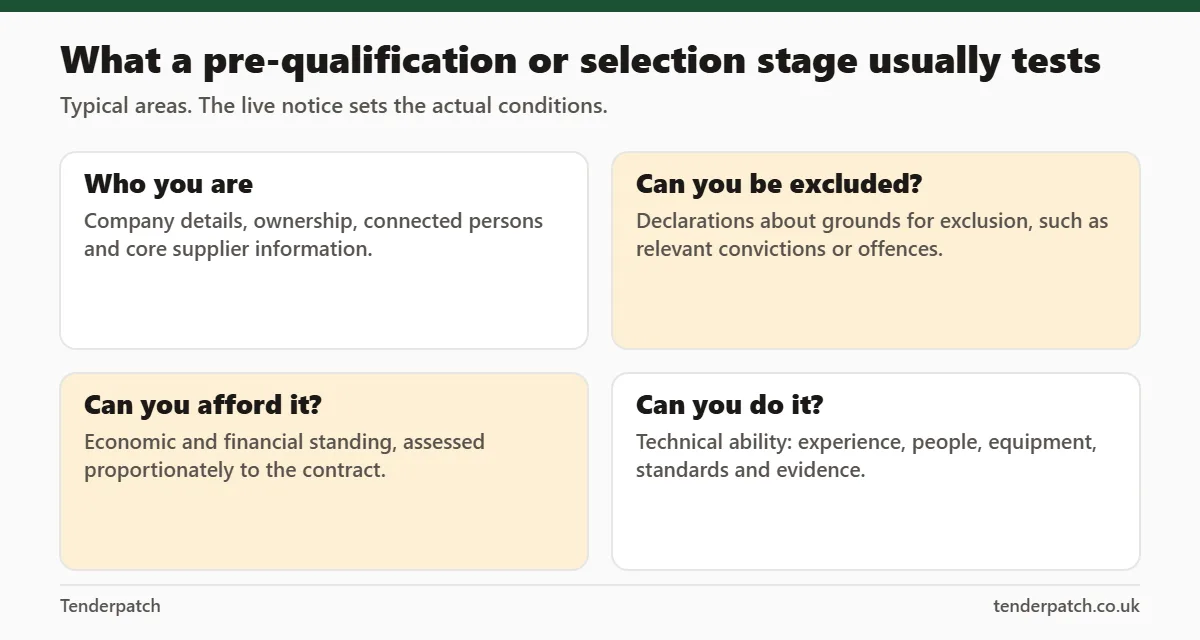
What buyers usually ask
Whatever it is called, a pre qualification questionnaire covers similar ground:
| Area | Typical questions | Limits in the guidance |
|---|---|---|
| Identity | Legal name, registered number, address, ownership and connected persons | Held on the central digital platform |
| Exclusion | Declarations about grounds for exclusion | Check the Exclusions guidance and the notice wording |
| Financial standing | Turnover, accounts or a credit rating | Audited accounts cannot be required unless you must already audit under company law |
| Insurance | Cover levels | Contract insurance cannot be required before award, though it can be required at contract start. Legally required cover, like employers’ liability, can be required |
| Technical ability | Experience, people, equipment, standards and references | Buyers cannot require experience with a specific authority, and must accept equivalent qualifications |
Preparing for the next tender? Start your 14-day free trial. No card is needed and nothing is charged automatically.
How to answer well
- Read the notice first. The conditions of participation sit there, and the questionnaire must match them.
- Answer the question asked. A pass or fail answer cannot be rescued by extra detail elsewhere.
- Be specific. Give numbers, dates, sites and named referees, not general statements.
- Use relevant experience. Public sector experience can be requested in general terms, and similar private work can still show you can deliver.
- Explain gaps. If you are still obtaining a standard, the guidance says a supplier may progress if it will hold the standard before award, subject to equal treatment.
- Check consortium and subcontract reliance. You can rely on a consortium partner, subcontractor or guarantor to meet conditions. Associated persons relied on must be named in the contract award notice.
Evidence to keep ready
- Company registration and accounts for the last two years, if available.
- Insurance certificates and levels of cover.
- Health and safety policy, accident records and risk assessments.
- Staff competence records and relevant qualifications.
- References and case studies with contact details.
- Evidence of any standards you hold, such as ISO certificates.
Common mistakes
- Treating the questionnaire as a formality. A failed condition can end your bid.
- Giving inconsistent figures between questions.
- Copying an old answer that no longer matches the question.
- Not telling the buyer about a change in company circumstances.
- Letting insurance or certificates expire during the procurement.
Worked example: a technical ability question
Suppose a questionnaire asks: “Describe two contracts of a similar size and nature delivered in the last three years.” Here is the difference between a weak and a strong answer. The details are invented to show the structure, so use your own true information.
| Weak answer | Stronger answer |
|---|---|
| “We have done lots of similar work for councils and housing associations and always deliver on time.” | “Contract 1: grounds maintenance of 22 sites for a housing provider, April 2023 to March 2026, with fortnightly visits in the growing season. Contract 2: verge and cemetery maintenance for a district council, 2024 to date. Referee names, roles and contact details are attached.” |
| No dates, values or referees | Dates, scope, contact details and what the buyer will be able to verify |
The stronger answer works because it is specific, checkable and relevant. The Cabinet Office’s conditions of participation guidance says evidence should be verifiable by a third party and should not be overly arduous, so make it easy for the buyer to check what you have said.
What if you do not meet a requirement?
- You are still obtaining a standard. The guidance says a supplier may progress if it will hold the standard before award, subject to equal treatment. Say so and give the date.
- A figure looks too demanding. Conditions must be proportionate. Raise a clarification question rather than guessing.
- You need help to qualify. You may rely on a consortium partner, subcontractor or guarantor, and associated persons relied on must be named in the contract award notice.
- You cannot meet it at all. A supplier must meet every condition to be awarded the contract, so it may be better to move on.
Frequently asked questions
What is a PQQ?
A PQQ, or pre qualification questionnaire, is a set of questions a buyer uses to check whether suppliers have the capability to deliver a contract. It is sometimes called a selection questionnaire.
Is the pre qualification questionnaire still used?
The Procurement Act 2023 does not require a standard questionnaire, but buyers can use their own forms. You may still see PQQs and selection questionnaires on notices.
Do I need audited accounts?
Not unless you are already required to have them under company law. Buyers cannot require audited accounts from suppliers that are not required to have them.
Do I need insurance to bid?
A buyer cannot require contract insurance to be in place before award, but it can require it at the start of the contract. Read the stated requirement.
To find notices with these conditions, see where to find UK public sector tenders and how Tenderpatch works.
Find Relevant UK Tenders with Tenderpatch
Discover public-sector contract opportunities relevant to your business and explore Tenderpatch’s tender-alert service, so you can prepare your evidence before the deadline. Start your 14-day free trial and see how it can simplify your tender search. No card is needed and nothing is charged automatically.
This guide is general information, not legal or procurement advice. Rules and thresholds change: check the official notice and current government guidance before you bid.