
A good UK tender search starts with Find a Tender, then checks the relevant national portal and the buyer’s submission website. There is no single search that replaces reading the official notice and its documents. For grounds maintenance, landscaping and tree work businesses, combining service keywords with a realistic delivery area is a practical starting point.
Checked against official guidance on 30 October 2026.
In this guide
How to run a UK tender search
- Decide your trade words (for example grass cutting, tree surgery, landscaping) and your delivery area.
- Search Find a Tender first. It carries notices under the Procurement Act 2023.
- Check Contracts Finder for earlier procurements and award records.
- Check the national portal for each nation you serve: Public Contracts Scotland, Sell2Wales, eTendersNI.
- Open the buyer’s own e-tendering portal to read the documents and submit. The notice will point you there.
Record the notice reference and closing time for anything you pursue.
Where to find UK public sector tenders: the main portals
| Service | When to use it | What to check next |
|---|---|---|
| Find a Tender | New procurement notices under the Procurement Act, plus other UK notices | Notice type, deadline and document link |
| Contracts Finder | Legacy procurement records, awards and supplementary searches | Whether bids are still being invited |
| Public Contracts Scotland | Opportunities with Scottish public bodies | Scottish notice and submission instructions |
| Sell2Wales | Opportunities with Welsh public bodies | Notice, documents and linked tender portal |
| eTendersNI | Northern Ireland public-sector opportunities | The portal specified by the buyer |
| Buyer’s e-tendering portal | Documents, questions and bid submission | Registration and the submission receipt |
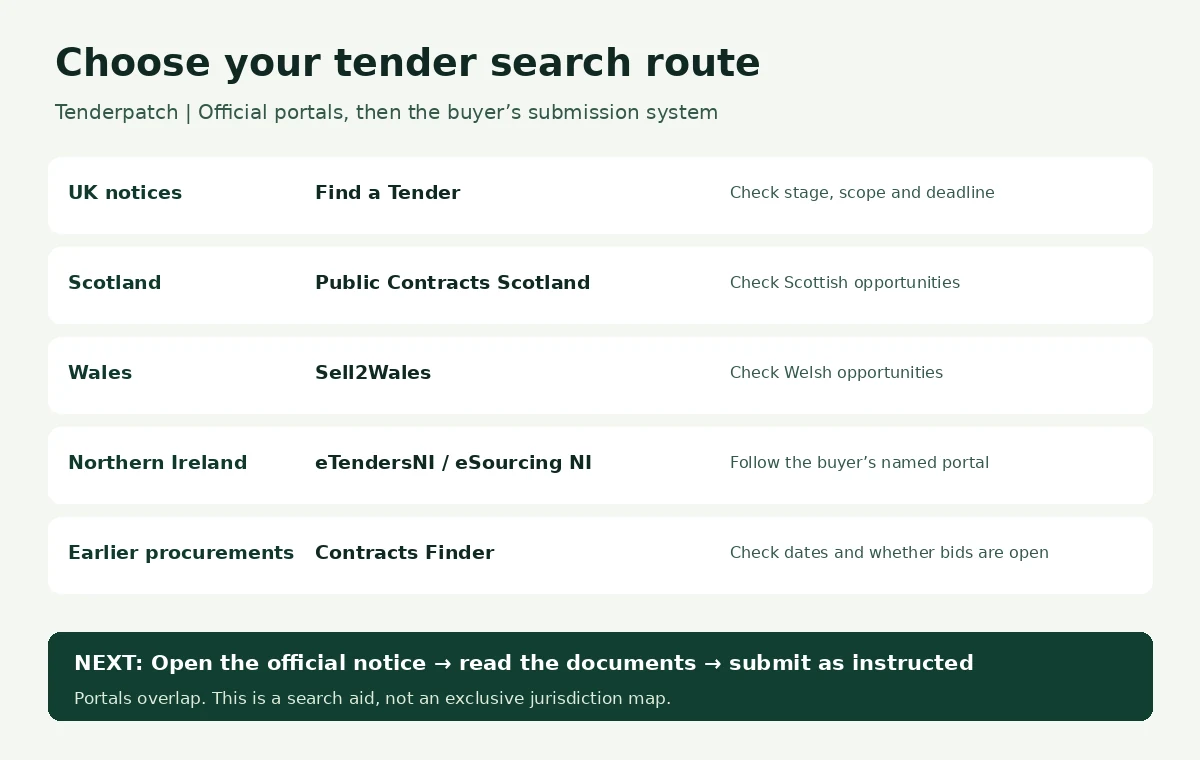
Start with Find a Tender for UK public sector tenders
Find a Tender is the central digital platform for notices under the Procurement Act 2023. The new regime began on 24 February 2025. Search notices for your work and distinguish a live invitation to tender from a pipeline, award or contract update. An award notice is useful market intelligence, but it is not an invitation to bid for that awarded contract.
Try separate searches for “grounds maintenance”, “grass cutting”, “landscaping”, “tree surgery” and “arboricultural services”. These are examples of search terms, not a guarantee that a buyer will use those exact words. Read the scope and lots: tree work may sit inside a wider estate maintenance contract. Our guide to grounds maintenance tenders shows a screening routine, and our guide to grass cutting contracts covers one common trade in more detail.
Want new matching notices sent to you instead of repeating the same searches? Start your 14-day free trial. No card is needed and nothing is charged automatically.
How Contracts Finder differs
Contracts Finder remains useful for researching earlier tenders, suppliers and awards, but do not assume every lower-value contract appears there. For procurements under the Procurement Act, the Cabinet Office’s below-threshold guidance explains that tender notices are published centrally on the central digital platform, which replaces the old requirement to publish only on Contracts Finder. Separate Contracts Finder publication guidance (PPN 019) applies only to procurements begun under the previous regulations before 24 February 2025, so older procurements and frameworks can continue under transitional rules.
Use both services as appropriate, but open each result and check its procurement stage, dates and latest updates before treating it as an opportunity.
Check Scotland, Wales and Northern Ireland separately
Scotland: Public Contracts Scotland
Include Public Contracts Scotland when looking for Scottish work. Do not apply an England-focused search routine or assume Procurement Act procedures govern every Scottish buyer. Scotland retains its own devolved procurement regime; follow the rules and instructions stated in the notice.
Wales: Sell2Wales
Sell2Wales is the Welsh digital platform. Welsh authorities have specific publication arrangements connecting it with the central digital platform. The Welsh Government’s digital-platform guidance explains those arrangements. Check both the advert and the linked submission service rather than assuming one account covers every system.
Northern Ireland: follow the buyer’s portal
eTendersNI is the Northern Ireland government’s e-tendering portal, and buyers may name a different portal for submission. The Department of Finance explains how to receive relevant eTendersNI alerts. Follow the portal named by the buyer and avoid assuming below-threshold rules are identical across all four nations.
What does below threshold mean?
“Below threshold” concerns contract value and the applicable legal regime; it does not mean “never advertised”. Under the Procurement Act’s regulated below-threshold rules, notifiable values generally start at £12,000 including VAT for central government authorities and £30,000 for other authorities. Exceptions and devolved arrangements matter: for example, the guidance says the below-threshold provisions do not apply to schools or to transferred Northern Ireland authorities in most circumstances. Where a buyer advertises a notifiable below-threshold contract, a below-threshold tender notice is required first.
These notification levels are different from the main thresholds for full procurement procedures. For 2026 to 2027, standard goods and services thresholds include £135,018 for central government and £207,720 for sub-central authorities, including VAT; different contract types have different thresholds. Check the current official threshold table and the below-threshold guidance. Do not use one headline figure to decide whether all council work must be advertised.
A repeatable search routine for small contractors
- Define your patch. List the areas your crews can serve profitably, including travel and emergency-response requirements.
- Search several service terms. Start broad, then add specialist terms. A buyer may describe the same work differently.
- Check the delivery location. The buyer’s office address may differ from the sites where work happens.
- Read the notice and lots. Record the scope, value basis, contract term, eligibility and exact deadline, including time.
- Open the submission portal early. Register where required, download documents and check the clarification deadline.
- Check updates before submitting. Save the latest documents and retain the portal’s submission receipt.
Keep a simple opportunity log for the UK public sector tenders you track with the notice reference, buyer, service, location, closing date and next action. Deduplicate by notice reference rather than title alone: similar titles can describe different contracts.
Search settings for UK public sector tenders
Whichever service you use, a few habits make results easier to judge. Where the service offers them, use filters for the notice stage and type, the location, and the classification code, then check the notice itself.
- Keywords: try the buyer’s likely wording, such as “grounds maintenance”, “open spaces”, “highways verges” or “arboricultural services”.
- Notice type: separate live invitations from pipeline notices, planned procurement and awards. Awards are market intelligence, not bids you can still submit.
- Classification codes: notices use Common Procurement Vocabulary (CPV) codes. Examples for outdoor work include 77314000 (grounds maintenance services), 77211500 (tree-maintenance services) and 77300000 (horticultural services). Buyers may choose different codes, so treat these as search aids rather than a complete list.
- Location: check the delivery sites in the documents, not just the buyer’s address.
- Dates: note the tender deadline and any earlier clarification deadline.
Registering and getting ready to bid
Searching the official notice services is free and does not need a bidding account. When you decide to bid, expect two layers of registration: your supplier information on the central digital platform, and an account on the buyer’s own e-tendering portal. The official supplier guide to the Procurement Act and guidance on using the central digital platform explain what each step involves.
Keep your core documents ready so a short deadline does not catch you out: your Companies House or sole-trader details, recent accounts, insurance certificates, health and safety policy, and examples of comparable work. GOV.UK’s plain-English page on selling to the public sector is a useful overview, and the full set of Procurement Act guidance documents is listed in one place.
What an alert service can and cannot do
What an alert can do. Run your searches for you, tell you when something new matches or a closing date moves, and save you repeating the same searches every morning.
What no alert can do. Guarantee complete coverage, read the documents for you, or turn a notice into a contract. Find a Tender and Contracts Finder both offer their own free alerts and searches. Paid services differ mainly in how they filter, explain and track what they find.
Tenderpatch specifically. It draws on official notices, mainly from Find a Tender, and matches them to grounds maintenance, landscaping, arboriculture and tree surgery, with the reason for each match, a daily or weekly email, flags for changed closing dates and cancellations on tenders you follow, and a tracker. It does not cover contracts advertised only on a council’s or parish council’s own website, or other trades such as cleaning or electrical work. Its Scottish coverage is partial, so keep Public Contracts Scotland in your routine for Scottish work. Tenderpatch is an independent service and is not part of or endorsed by the UK Government.
Common mistakes when searching for UK public sector tenders
- Searching only one portal and assuming it is complete.
- Treating an award notice as an open opportunity.
- Using a single keyword and missing contracts described differently.
- Ignoring lots, where tree or grounds work sits inside a wider estates contract.
- Reading only the notice and not the tender documents and deadlines.
- Leaving registration until the day before the deadline.
Frequently asked questions
Can I find public tenders without paying?
Official notice services allow free searching. Paid alert services can help with discovery and sorting, but they do not replace the official documents or guarantee contract wins.
Does finding a notice mean I can bid?
No. Check whether it is open, which lot fits your business, and the buyer’s requirements. Some records concern completed awards or opportunities restricted to an existing purchasing arrangement.
Where do I send the tender?
Use the submission route in the notice and documents. A listing service or email alert is not necessarily the system that receives your bid.
How often should I check for new tenders?
Many contractors check daily or set up alerts, because tender periods can be short. Check the official notice for the exact deadline and any earlier clarification deadline.
Do I have to register before I can search?
No. You can search the official notice services without an account. You will usually need to register on the buyer’s portal when you decide to bid.
Are contracts below the thresholds advertised?
Often, but the rules differ by value, buyer type and nation. Notifiable below-threshold contracts require a below-threshold notice, so check the guidance and the relevant portal rather than relying on one headline figure.
Where to go next
Once you can search reliably, the next step is deciding which tenders to pursue. Read our trade guides to grounds maintenance tenders, grass cutting contracts, parish council grounds maintenance tenders and landscaping tenders, or browse all the tender guides. See which industries Tenderpatch covers, or read how Tenderpatch works and its features. The pricing page lists current plans and the FAQ answers common questions. Always verify an opportunity against its official notice before bidding.
Search for grounds, landscaping and tree tenders
If your trade is grounds maintenance, landscaping, arboriculture or tree surgery, browse open tenders without an account, or try Tenderpatch free for 14 days (no card needed, nothing charged automatically).
This guide is general information, not legal or procurement advice. Rules and thresholds change: check the official notice and current government guidance before you bid.