Government contracts for small businesses are real and regularly awarded, but winning them depends on knowing where they are advertised, what buyers will ask for and how to decide which are worth bidding for. This guide explains how the UK system works for a small contractor and how recent procurement rules are intended to help smaller suppliers.
Checked against official guidance on 23 October 2026. Tenderpatch is not a legal adviser: always rely on the official notice and documents before you bid.
In this guide
What counts as a small business
Most guidance on government contracts for small businesses uses the term SME. The Procurement Act 2023 defines a small or medium-sized enterprise (SME) at section 123(1). GOV.UK’s SME definition guidance says an SME has fewer than 250 full-time equivalent staff, and either annual turnover of £44m or less or a balance sheet total of £38m or less, with adjustments for ownership and linked businesses. Most sole traders and small contractors fall comfortably inside it.
The same guidance notes that 99.2% of UK businesses are small, with fewer than 50 employees, so you are not unusual if you are new to public work.
How the rules help smaller suppliers
The GOV.UK short guide for suppliers describes several changes introduced when the new rules took effect on 24 February 2025. In summary:
- Buyers are expected to remove barriers that prevent smaller businesses competing.
- Suppliers can benefit from 30-day payment terms on a broader range of public contracts, with the terms also flowing down to relevant subcontractors.
- Buyers must provide assessment summaries to suppliers whose tenders were assessed, so you can see why you won or lost.
- A competitive flexible procedure sits alongside the open procedure.
- Frameworks must be reopened so suppliers are not shut out for long periods. See the guidance on frameworks.
Below the main thresholds, the below-threshold guidance says buyers cannot use a separate suitability stage to reduce the number of suppliers who can submit tenders. It also says authorities may restrict some competitions to SMEs or local suppliers, so look for that wording.
Where to find government contracts for small businesses
GOV.UK’s guide to selling to the public sector lists the main routes. For most contractors that means:
| Route | What it is for | Notes |
|---|---|---|
| Find a Tender | Notices under the Procurement Act, free to search | Find a Tender also lets you save searches and get email alerts |
| Contracts Finder | Legacy and some below-threshold records in England and non-devolved bodies | Check the notice to see whether bids are still invited |
| Devolved portals | Scotland, Wales and Northern Ireland publish through their own services | Public Contracts Scotland and Sell2Wales |
| Local councils | Contact them about becoming an approved supplier | GOV.UK recommends this route, and many councils publish their own tenders |
| Tenderpatch | Find a Tender notices matched to grounds, landscaping and tree trades | Free 14-day trial, no card needed |
Want to spend less time searching for public-sector opportunities? Start your 14-day free trial. No card is needed and nothing is charged automatically.
What to have ready before you bid
The supplier guide lists the core information you may need when you register on Find a Tender and bid: your Companies House number if you have one, address, website and email, the last two years of accounts if available, details of connected people or businesses and anyone with significant control, and details of any convictions or offences. It also says this information is stored for reuse across bids.
Whichever government contracts for small businesses you target, prepare a small library you can reuse:
- Insurance certificates for public liability, employers’ liability and any other cover your trade needs. A buyer cannot require contract insurance before award but can require it at contract start, according to the conditions of participation guidance.
- Health and safety policy, risk assessments and method statements.
- Case studies and references from similar work, public or private.
- CVs or competence summaries for key staff.
- Standard answers on quality, environmental and social questions to adapt.
Choosing which government contracts for small businesses to bid for
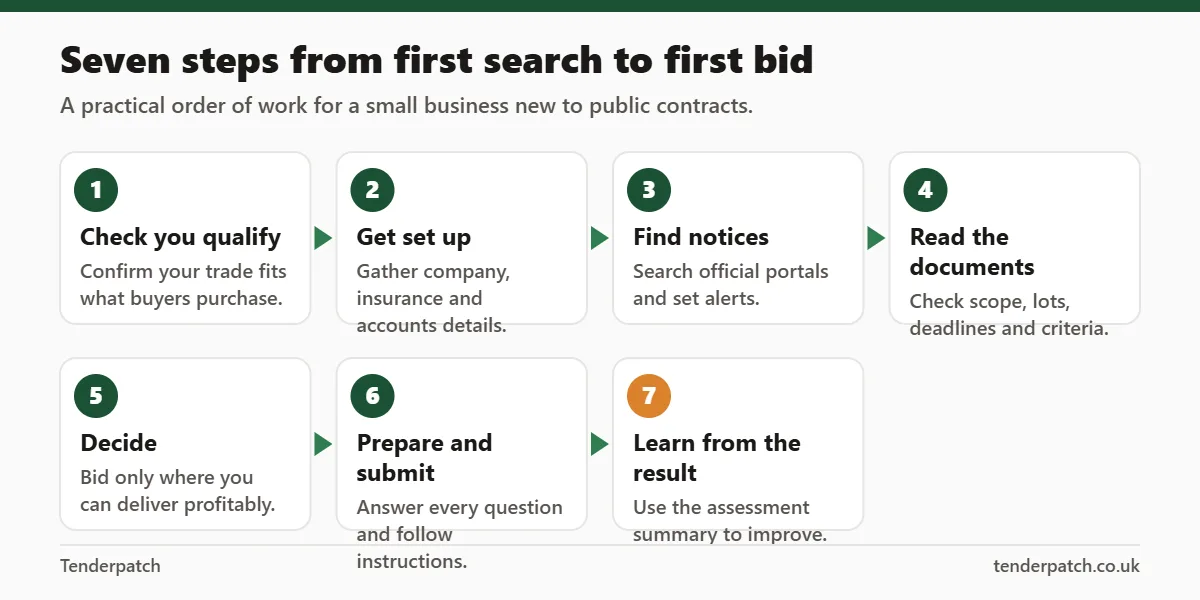
Winning a few well-chosen government contracts for small businesses beats writing many weak bids. Before committing hours, check:
- Is the work something you do now, at a scale you can handle?
- Can you meet the stated conditions of participation?
- Is the contract divided into lots that suit you?
- Do the term, payment terms and risk allocation make commercial sense?
- Does the evaluation reward quality, or is price decisive?
- Do you have the time to answer properly before the deadline?
Other routes into government contracts for small businesses
You do not have to win a prime contract. Subcontracting to a main contractor, joining a framework when it reopens, or consortium bidding with other small firms can all be ways in. In each case read the terms: the guidance says suppliers may rely on consortium partners, subcontractors or guarantors to meet conditions of participation, and the associated persons relied on must be named in the contract award notice.
Common mistakes
- Waiting until a tender looks perfect. Buyers publish documents for a set period, and the closing date will not move for you.
- Ignoring small contracts because they seem unimportant. They can be a good first reference.
- Copying answers between bids without reading the question.
- Leaving out evidence the question clearly asks for.
- Assuming a framework place guarantees work. It does not.
Frequently asked questions
Can a small business win government contracts?
Yes. Many contracts are awarded to small businesses, and recent rules aim to reduce barriers for them. Success depends on fit, preparation and a good answer to the buyer’s criteria.
Where can I find government contracts for small businesses?
Start with Find a Tender, then check Contracts Finder, the devolved portals and your local councils. Alerts reduce repeated searching.
Do I need to register before I can see tenders?
No. You can search and view opportunities on Find a Tender without registering your organisation. The supplier guide says you only need to register when you want to bid.
How does Tenderpatch help small contractors?
Tenderpatch filters Find a Tender notices by trade and patch for grounds maintenance, landscaping, arboriculture and tree surgery, and shows the reason for each match. It starts with a 14-day free trial, with no card needed and nothing charged automatically.
Government contracts for small businesses reward patience and preparation. To keep learning, read where to find UK public sector tenders or see what Tenderpatch includes.
Find Relevant UK Tenders with Tenderpatch
Simplify the process of finding suitable public contracts for your grounds, landscaping or tree business. Explore Tenderpatch’s tender-alert service. Start your 14-day free trial and see how it can simplify your tender search. No card is needed and nothing is charged automatically.
This guide is general information, not legal or procurement advice. Rules and thresholds change: check the official notice and current government guidance before you bid.