Local authority contracts cover a huge range of work, from grounds maintenance and tree work to building repairs and waste. For contractors, the challenge is knowing which councils buy what, how large contracts must be before they are advertised and where to look so you can see work before the deadline is close. This guide explains the practical routes to local authority contracts in England and the wider UK.
Checked against official guidance on 23 October 2026. Tenderpatch is not a legal adviser: always rely on the official notice and documents before you bid.
In this guide
Which councils buy what
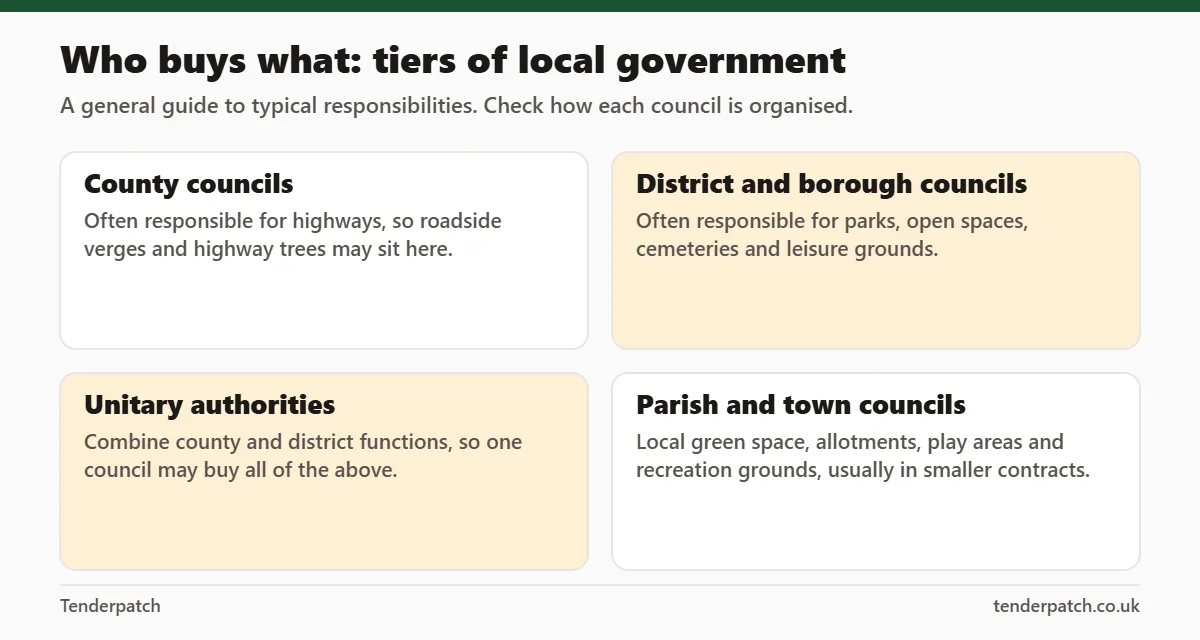
Different tiers of local government have different responsibilities, and the arrangements vary between England, Scotland, Wales and Northern Ireland. In many English areas, county councils run highways, district councils run parks and open spaces, unitary authorities do both, and parish councils manage local green space. If you do grounds, landscaping or tree work, knowing who owns the land you want to work on tells you which council to watch.
Contract values and what triggers a notice
Under the Procurement Act thresholds applicable from 1 January 2026, GOV.UK’s thresholds guidance gives £207,720 including VAT for goods or services contracts of sub-central authorities such as councils, and £5,193,000 for works contracts. Below those values the below-threshold guidance says notifiable contracts for authorities other than central government start at £30,000 including VAT, and that a below-threshold tender notice is required before advertising a notifiable contract.
Smaller contracts can still be advertised or put out to quotation on council websites. Do not assume that a lower value means no opportunity.
Where local authority contracts are published
| Source | What it shows | Notes |
|---|---|---|
| Find a Tender | Tender notices, award notices, pipeline notices and frameworks | Find a Tender is free to search |
| Council procurement pages | Tenders, quotes and supplier registration | Often hold smaller contracts and local instructions |
| Council contract registers | Existing contracts, suppliers, values and end dates | Useful for knowing when a contract will be re-tendered |
| Buyer portals | Documents, clarification and submission | You may need to register to see the documents |
| Devolved portals | Scottish, Welsh and Northern Ireland opportunities | Public Contracts Scotland, Sell2Wales and the Northern Ireland alerts guide |
Searching several council sites for local authority contracts takes time. Start your 14-day free trial. No card is needed and nothing is charged automatically.
Seeing local authority contracts before they are tendered
- Award notices. These show who won a contract, its value and its term. A three-year contract awarded in 2024 will normally be re-tendered before it ends.
- Pipeline notices. Large authorities with annual spend above £100m must publish a pipeline notice for each upcoming contract worth more than £2 million, according to the GOV.UK pipeline notice guide. You can search Find a Tender for the notices and filter by CPV code or suitability for SMEs.
- Council meeting papers. Cabinet reports often discuss contracts due to be renewed.
- Contract registers. Many councils publish them, which shows end dates and extension options.
Pipeline notices only cover larger contracts, so small contracts can arrive with little warning.
Getting on supplier lists
GOV.UK’s guide to selling to the public sector suggests contacting local councils about becoming an approved supplier. Some councils keep lists of suppliers they invite to quote for low-value work. Being on one does not guarantee work, but it can mean invitations you would not otherwise see. Find the procurement or contracts page of each council you want to work for, and register.
A weekly routine
- Check Find a Tender for new notices that match your trade and area.
- Check your target councils’ procurement pages.
- Review award notices for contracts ending in the next 12 months.
- Update your supplier registrations and insurance documents.
- Record deadlines and decisions in one place.
Researching one council: a worked routine
Pick a single council you could realistically serve and build a profile of how it buys. The example below is a hypothetical routine, and each step uses sources named elsewhere in this guide.
- Identify the services you could supply. For a grounds firm, that might be parks, cemeteries, housing land or highway verges, depending on the tier of council.
- Search Find a Tender for the council’s name plus your trade terms, and open every notice type: tenders, awards and pipeline notices.
- Record each contract with its supplier, start date, term and extension options, so you can predict re-tender dates.
- Check the council’s procurement page for supplier registration, forward plans and contract registers.
- Read the standing orders or contract procedure rules, where published, to see when quotes or formal tenders are used.
- Set an alert for the council and trade, and a diary reminder for each expected re-tender date.
Repeat for three or four councils and you will have a rolling picture of what is likely to come up in your area, rather than reacting to each notice as it appears.
Questions worth asking a council’s procurement team
- How do you advertise contracts below the main thresholds, and where?
- Do you keep a supplier list, and how do I join it?
- When are the current grounds, landscaping or tree contracts due to be renewed?
- Do you split contracts into lots, and can I bid for one lot?
- How do you evaluate quality and price, and is social value scored?
Procurement officers cannot give any bidder an advantage on a live tender, but they can usually explain how the council buys and where to look.
Frequently asked questions
Where can I find local authority contracts?
Start with Find a Tender, then check each target council’s procurement or tenders page and its contract register. Devolved nations use their own portals.
Do councils have to advertise all contracts?
No. It depends on value and the type of contract. Below the thresholds, rules are lighter, and some contracts are offered by quotation or invitation.
How do I find out when a council contract will be re-tendered?
Look at award notices and contract registers for end dates and extension options, and check pipeline notices for large contracts.
Does Tenderpatch cover local authority contracts?
Tenderpatch covers local authority notices published on Find a Tender for grounds maintenance, landscaping, arboriculture and tree surgery, shown by council area. Contracts published only elsewhere are not included.
For a wider look at where to search, see where to find UK public sector tenders and the trades Tenderpatch covers.
Find Relevant UK Tenders with Tenderpatch
Discover public-sector contract opportunities relevant to your business and explore Tenderpatch’s tender-alert service, shown by council and region. Start your 14-day free trial and see how it can simplify your tender search. No card is needed and nothing is charged automatically.
This guide is general information, not legal or procurement advice. Rules and thresholds change: check the official notice and current government guidance before you bid.