An invitation to tender (ITT) is the set of documents a public buyer issues to ask suppliers for formal bids. It explains what is being bought, how bids will be assessed, what to submit and by when. Reading the invitation to tender closely is the most reliable way to avoid wasted bids, because most mistakes come from missing something that was written down.
Checked against official guidance on 23 October 2026. Tenderpatch is not a legal adviser: always rely on the official notice and documents before you bid.
In this guide
What an invitation to tender is
An invitation to tender is the buyer’s formal request for offers. The Procurement Act’s own terms are tender notice and tender documents, and its guidance on competitive tendering procedures describes the tender notice as the key notice that starts the procedure. Many buyers still call the pack of documents an ITT, so the two are often used together: the notice publicly advertises the opportunity and the invitation to tender documents explain how to bid.
A notice on Find a Tender may link to the documents or hold them on the buyer’s own e-tendering portal. You may need to register there to download them.
What is in an invitation to tender
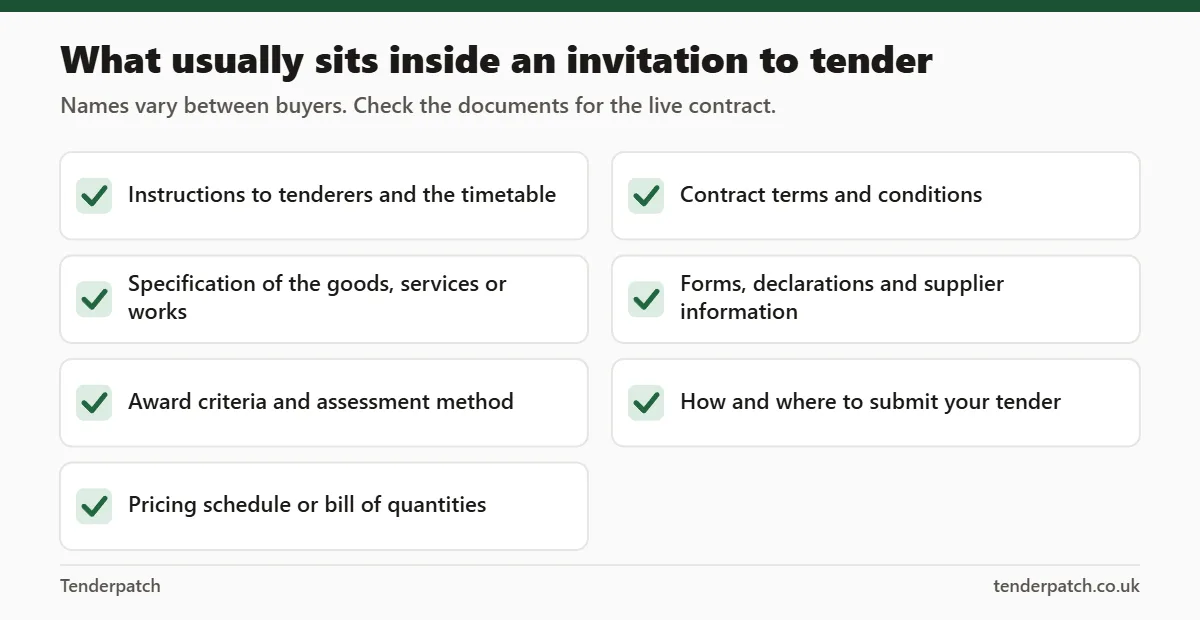
Documents differ by buyer and value, but a typical invitation to tender includes:
- Instructions to tenderers. The timetable, submission method, clarification rules and anything that would disqualify a bid.
- Specification. What the buyer wants delivered, to what standard and where.
- Award criteria and assessment method. What will be scored, and how it will be weighted. The Act requires award criteria and the assessment methodology, or a summary of them, to be published in the tender notice, with further details in the tender documents if not published in full.
- Pricing schedule. The form in which you must give your price.
- Contract terms. The conditions you will have to accept if you win, including payment and termination.
- Forms and declarations. Supplier information, conflicts of interest and any other statements.
How to read an invitation to tender
Read in this order, with a highlighter and a notes sheet:
- Dates first. Clarification deadline, submission deadline and time, and expected start date.
- The pass/fail items. Conditions of participation and mandatory requirements. A supplier must meet every condition to be awarded the contract, per the conditions of participation guidance.
- Award criteria. Weightings and scoring, then match each question to a section in your answer.
- The specification and pricing schedule together. Make sure you price everything the specification requires.
- The contract terms. Note payment terms, liability and termination. Ask a clarification question if something looks unreasonable.
Want to spend less time searching for public-sector opportunities? Start your 14-day free trial. No card is needed and nothing is charged automatically.
How to respond
A good response mirrors the invitation to tender’s structure so the evaluator can find each answer easily.
- Create a compliance table listing every requirement and where your response meets it.
- Answer each question directly. Use the same terms the buyer uses.
- Give evidence, such as figures, dates, named sites, photographs and references, rather than general claims.
- Keep to word or page limits. Do not assume extra material will be read.
- Complete every form and sign where required.
- Submit through the stated route and keep the receipt.
The guidance on assessing competitive tenders says assessment must follow the published methodology and the relative importance of the criteria, which is why answering the question that was asked matters more than showing everything you can do.
ITT, RFQ and tender notice: the differences
| Term | What it usually means | Use |
|---|---|---|
| Tender notice | The public notice that advertises the procurement and sets key rules | Starting point on Find a Tender |
| Invitation to tender (ITT) | The pack of documents inviting formal bids | Read before you decide to bid |
| Request for quotation (RFQ) | A simpler request, often for lower-value work | Check the buyer’s own rules about when quotes are enough |
Common mistakes
- Starting to write before you have read the whole invitation to tender.
- Missing a mandatory form or a signature.
- Pricing from the notice summary rather than the pricing schedule.
- Not asking a clarification question about ambiguous requirements.
- Leaving submission until the last hour, when portals are slow.
Example: structuring a response to a grounds ITT
This outline is a hypothetical response structure for a council grounds maintenance invitation to tender. Your own documents will set different questions and limits, so adapt it.
| ITT section | What the buyer asks | How to structure your answer |
|---|---|---|
| Method statement | How you will deliver the service across the sites | Open with your approach, then describe crews, equipment and the visit schedule by site type |
| Resources | People, plant and supervision | Give crew sizes, named supervisors and equipment, and cover for absence and breakdowns |
| Health and safety | Policies, risk assessments and incident records | Attach the policy, give an example risk assessment and explain how you brief crews |
| Mobilisation | How you will start on time | A dated plan with responsibilities and any equipment you will buy or hire |
| Price | The completed pricing schedule | Fill in every line, check totals and make sure the price matches your resources |
Notice that each answer starts by responding to the question and then gives evidence. If the invitation to tender gives a word limit, treat it as firm. If it scores answers on a scale, work out what a top-scoring answer would need and write to that.
Using clarification questions well
- Ask about anything that changes your price or approach, such as unclear quantities, access arrangements or start dates.
- Keep questions short and numbered, referring to the document and section.
- Use the buyer’s official channel and keep a copy of the answer.
- Do not reveal your price or strategy in a question that other bidders may see.
Frequently asked questions
What does invitation to tender mean?
It means the buyer’s formal request for bids, normally a pack of documents explaining the requirement, how bids will be assessed and how to submit.
Is an invitation to tender the same as a tender notice?
No. The tender notice advertises the opportunity and starts the procedure. The invitation to tender documents contain the detailed instructions and requirements.
What should I do first with an invitation to tender?
Note the dates, check the conditions you must meet and read the award criteria. Then decide whether to bid.
Where can I find an invitation to tender?
Through the notice on Find a Tender or the buyer’s e-tendering portal. Tenderpatch links every matched tender to the original notice.
For more on how the stages fit together, read where to find UK public sector tenders and see how Tenderpatch works.
Find Relevant UK Tenders with Tenderpatch
Discover public-sector contract opportunities relevant to your business and explore Tenderpatch’s tender-alert service, with every match linked to the official notice. Start your 14-day free trial and see how it can simplify your tender search. No card is needed and nothing is charged automatically.
This guide is general information, not legal or procurement advice. Rules and thresholds change: check the official notice and current government guidance before you bid.