
The tender process is the sequence a public buyer follows to invite offers, assess them and award a contract. In the UK the usual stages are planning, a published notice, clarification questions, submission, evaluation, feedback, a standstill period and the contract. Knowing the steps tells you when to ask questions, when to prepare and what feedback you can expect.
Checked against official guidance on 23 October 2026. Tenderpatch is not a legal adviser: always rely on the official notice and documents before you bid.
In this guide
The tender process at a glance
The Procurement Act 2023, which took effect for new procurements on 24 February 2025, sets the rules for most public contracts in England and non-devolved bodies, with different arrangements in the devolved nations. The stages below describe a typical competitive procedure. The particular contract’s notice and documents always take priority.
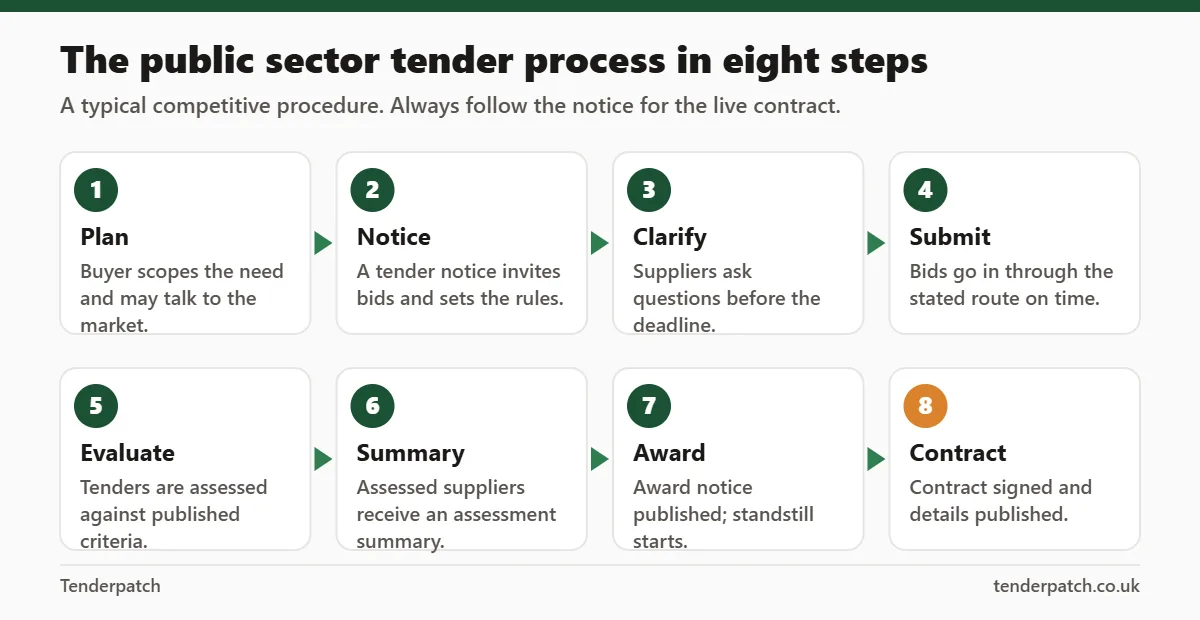
Step 1: planning and market engagement
Before a contract is advertised, the buyer decides what it needs, how long the contract will run and how it will be bought. It may talk to suppliers through preliminary market engagement and may publish a planned procurement or pipeline notice. Pipeline notices are required only from large authorities for contracts over £2 million, according to the GOV.UK pipeline notice guide, so many smaller contracts appear with no warning.
Step 2: the notice and the procedure
The buyer publishes a tender notice on Find a Tender. The guidance on competitive tendering procedures describes two main options:
| Procedure | How it works | What it means for you |
|---|---|---|
| Open procedure | A single stage: any interested supplier can submit a tender | Everyone who meets the conditions can bid |
| Competitive flexible procedure | Any other procedure the buyer considers appropriate, which can include shortlisting and negotiation | Read the notice to see whether there is a selection stage first |
The notice states the conditions of participation, the award criteria, how to submit and the deadline. Conditions of participation test your legal and financial capacity or technical ability to perform the contract and must be proportionate. See the guidance.
Searching for new notices every week is slow. Start your 14-day free trial. No card is needed and nothing is charged automatically.
Steps 3 and 4: clarify and submit
Use the clarification route stated in the documents to ask about anything unclear, and read other bidders’ questions and answers where the buyer publishes them. Do not assume an informal chat with the buyer counts.
The time periods guidance sets minimum tendering periods. For an open procedure, the baseline is 25 days where tenders are submitted electronically and all documents are provided with the notice, and 30 or 35 days if submission is not electronic or documents are not all provided. A competitive flexible procedure can add a participation period of at least 25 days. These are minimums, so check the closing date for the real contract.
Step 5: evaluation
Buyers must award to the supplier that submits the most advantageous tender, the one that best meets the published award criteria, using the stated assessment method. Tenders that fail the conditions of participation are disregarded. Lowest price is permitted as a sole criterion but is described as unlikely to be suitable for most contracts. The guidance on assessing competitive tenders explains how weightings and scoring should be published.
If a buyer considers a price abnormally low, it must notify you and give you a reasonable opportunity to show you can perform at that price before it can disregard the tender.
Steps 6 to 8: summary, award and contract
- Assessment summary. Before publishing the contract award notice, the buyer must give suppliers whose tenders were assessed an assessment summary showing their scores and reasons. The assessment summaries guidance says it should go to all relevant suppliers at the same time.
- Award notice and standstill. The award notice starts a standstill period of at least eight working days, during which a legal challenge can pause the signing of the contract. Some contracts, including call-offs from frameworks, are exempt. See the standstill guidance.
- Contract. The contract is signed and a contract details notice is published afterwards.
What changes below threshold or in the devolved nations
Not every contract follows the full process. Regulated below-threshold contracts have lighter rules, including a below-threshold tender notice where a contract is notifiable and advertised. See the below-threshold guidance. Scotland, Wales and Northern Ireland have their own procurement rules and portals, so check the relevant service. The Procurement Act does not simply apply across all four nations.
Planning your own bid timetable
Work backwards from the closing date. A realistic plan for a typical tender process:
- Day 1 to 3: read the documents and decide whether to bid.
- As early as possible: submit clarification questions.
- Middle period: draft answers, gather evidence and get supplier quotes.
- Final days: complete the price schedule, check every mandatory field and read the submission instructions again.
- At least a day before the deadline: submit and keep the portal receipt.
An illustrative timeline using the minimum periods
The timings below use the minimums in the official guidance for an open procedure with electronic submission, so a real tender may be longer. They are an illustration of how the stages stack up, not a promise of how any buyer will run its process.
| Stage | Timing in this illustration | Source of the timing |
|---|---|---|
| Tender notice published with all documents | Day 0 | Buyer’s decision |
| Earliest tender deadline | Day 25 at the earliest | Minimum tendering period for open procedures where tenders are submitted electronically and all documents are provided with the notice |
| Evaluation and moderation | Set by the buyer | Not fixed by the rules |
| Assessment summaries sent | Before the award notice is published | Assessment summaries guidance |
| Contract award notice published | Standstill starts the same day | Standstill guidance |
| Standstill | At least eight working days | Standstill guidance |
| Contract signed | After the standstill ends | Buyer’s decision |
What this tells you: the part you control, preparing your bid, is bounded by the tender period, while the weeks after submission depend on the buyer. If a contract needs to start by a given date, check whether the programme in the documents leaves enough time for evaluation and standstill. If it does not, ask a clarification question, because the start date may move.
Frequently asked questions
How long does the tender process take?
It varies. The tendering period alone has a minimum set by the rules, and evaluation, standstill and contract signing follow. Check the notice for the dates that apply to a given contract.
Can I ask questions during the tender process?
Yes, through the clarification route in the documents. Ask early and keep a record of the answers.
Will I get feedback if I lose?
For competitive tenders, suppliers whose tenders were assessed must receive an assessment summary before the award notice. It shows your scores and reasons.
Where do I start with the tender process?
Search Find a Tender and relevant devolved portals, set alerts, and read documents carefully before committing time. Tenderpatch can match notices to your trade and area.
For finding notices, see where to find UK public sector tenders. If you are weighing whether to bid at all, Tenderpatch’s process shows how matched tenders are presented with the reasons shown.
Find Relevant UK Tenders with Tenderpatch
Discover public-sector contract opportunities relevant to your business and explore Tenderpatch’s tender-alert service to catch notices before the deadline pressure builds. Start your 14-day free trial and see how it can simplify your tender search. No card is needed and nothing is charged automatically.
This guide is general information, not legal or procurement advice. Rules and thresholds change: check the official notice and current government guidance before you bid.