How to win a tender is less about clever writing than about choosing the right bids and then doing the basics well: answer the question, prove what you say, price honestly and submit complete. Buyers must award to the most advantageous tender, the one that best meets their published criteria, so winning means scoring more marks on those criteria than your competitors.
Checked against official guidance on 23 October 2026. Tenderpatch is not a legal adviser: always rely on the official notice and documents before you bid.
In this guide
Choose the tenders you can win
The first step in how to win a tender is deciding which tenders to bid for. Most small contractors lose time by bidding for everything. Before you commit hours, ask:
- Can I meet every condition of participation? A supplier must meet all of them to be awarded the contract.
- Do I have recent, relevant evidence of similar work?
- Can I deliver profitably at the likely price?
- Do I have the capacity to start on the date given?
If the answer is no to two or more, move on. A structured go or no-go decision protects your time.
How to win a tender: read the criteria and write to them
The Cabinet Office’s guidance on assessing competitive tenders says award criteria and the assessment methodology, or a summary of them, must be published in the tender notice, and that assessment must follow the published methodology and the relative importance of the criteria. That tells you exactly where marks come from.
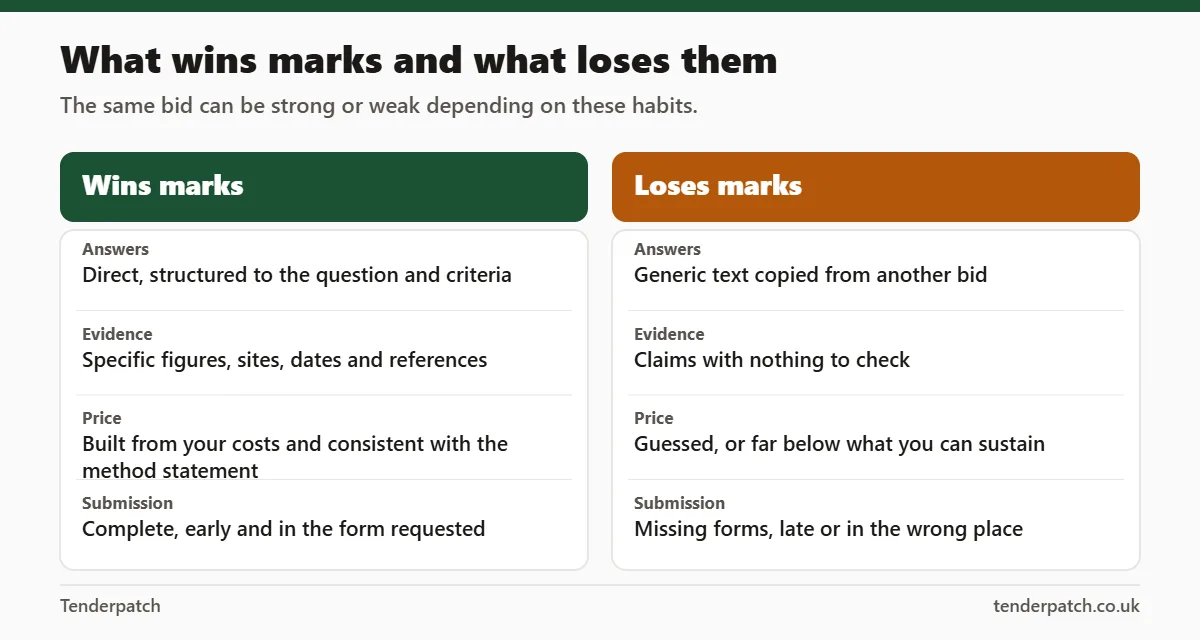
- Make a table of every question, its weighting and its word limit.
- Give most effort to the highest-weighted questions.
- Use the buyer’s own words in your headings so evaluators can find your answers.
- Answer each part of a multi-part question in order.
How to win a tender with evidence, not claims
Knowing how to win a tender means knowing that evaluators score what is written in your bid, not what they hope you can do. Replace claims with evidence.
| Instead of | Write |
|---|---|
| “We are experienced.” | “We have maintained 14 council sites for three years, including cemeteries and sports pitches.” Use your own true figures. |
| “We respond quickly.” | “Our depot is 20 minutes from the main site, and we commit to attending within the time set in the specification.” |
| “We care about safety.” | “Every crew completes a documented site risk assessment before starting, kept for inspection.” |
These examples show the style. Always use your own true details. Never invent contracts, figures or references.
Want to spend less time searching for public-sector opportunities? Start your 14-day free trial. No card is needed and nothing is charged automatically.
Pricing: how to win a tender and still make a profit
Learning how to win a tender on price alone rarely works as a strategy. The same guidance says lowest price as the only criterion is unlikely to be suitable for most contracts, and abnormally low prices must be investigated. Price to cover your costs, risk and margin, then check the number against the scoring method so you understand its effect.
Make the bid easy to score
- Short paragraphs, clear headings and plain English.
- Tables for schedules, responsibilities and timetables.
- Photographs, maps or diagrams where they replace long descriptions.
- A completed compliance table showing where each requirement is met.
- A final proofread by someone who did not write it.
Learn from every result to improve how to win a tender next time
For competitive tenders, buyers must provide suppliers whose tenders were assessed with an assessment summary before the award notice is published. According to the assessment summaries guidance, it includes scores for each criterion and sub-criterion and a justification referring to the tender. Unsuccessful suppliers also receive information on the winning tender’s scores. After every result:
- Compare your scores against the winner’s, question by question.
- Identify which answers lost marks and why.
- Update your reusable library of answers and evidence.
- Decide whether to challenge or simply improve. A legal challenge during the standstill can pause the contract, but take advice before you start one.
What loses a tender
- Failing a condition of participation or a mandatory requirement.
- Missing the deadline or submitting in the wrong place.
- Answering a different question from the one asked.
- Pricing that does not match the method statement.
- Copying old answers with the wrong buyer’s name still in them.
Review your bid like an evaluator
Before you submit, ask someone who has not worked on the bid to score it against the published criteria. Give them the scoring scale and the weightings, and ask them to mark each answer and write down why. Where they give a low score, ask what they would need to see to give a higher one.
- Give the reviewer the documents and your draft at least two days before the deadline.
- Ask for scores, not general comments.
- Fix the lowest-scoring answers that carry the highest weighting first.
- Check compliance last: forms, signatures, limits and file names.
Build a bid library
Most of what you write can be reused if you keep it organised. A good library saves hours on each bid and improves consistency.
- Policies, certificates and insurance documents with expiry dates.
- Case studies with photographs, dates and referee details.
- Standard method statements for each service line, ready to adapt.
- Biographies and competence records for your key staff.
- A log of each bid, the scores you received and the lessons you learned.
The library is a starting point only. Evaluators score the answer to the question in front of them, so adapt every reused paragraph to the buyer, the sites and the criteria.
Frequently asked questions
How do I win a tender for the first time?
Pick a tender that matches work you already do, read the criteria carefully, give evidence for every claim and price from your own costs. A first win is usually a good fit, not a stretch.
Is how to win a tender the same as writing a good proposal?
Writing matters, but selection of the right bids, pricing and compliance matter as much. A well-written bid for the wrong contract still loses.
How many tenders should I bid for?
Fewer, better bids usually beat many hurried ones. Set a threshold for bidding and stick to it.
Where can I find tenders to bid for?
On Find a Tender, council websites and the portals named in notices. Tenderpatch filters Find a Tender notices by trade and patch.
How to win a tender is a skill you build over several bids. To find more bids that fit, see where to find UK public sector tenders and how Tenderpatch works.
Find Relevant UK Tenders with Tenderpatch
Discover public-sector contract opportunities relevant to your business and explore Tenderpatch’s tender-alert service, so you can focus on the tenders you can win. Start your 14-day free trial and see how it can simplify your tender search. No card is needed and nothing is charged automatically.
This guide is general information, not legal or procurement advice. Rules and thresholds change: check the official notice and current government guidance before you bid.