A strong tender submission is mostly organisation: the right documents, answers that match the questions, a price schedule that agrees with the specification and a file the portal will accept before the deadline. The best-written bid still fails if it is late, incomplete or not in the form requested.
Checked against official guidance on 23 October 2026. Tenderpatch is not a legal adviser: always rely on the official notice and documents before you bid.
In this guide
Organise before you write
Start by reading the whole pack, then set up a working folder with one file per question and a master list of deadlines. Note the clarification deadline, the closing date and time, and any requirement to register on the buyer’s portal in advance.
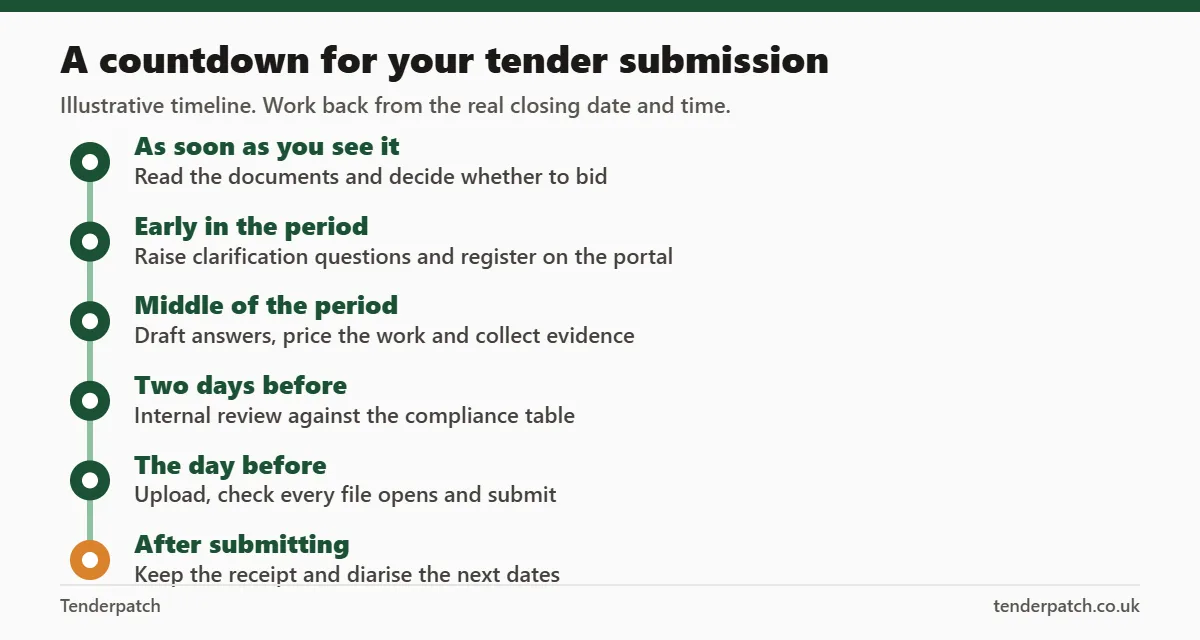
The time periods guidance sets minimum tendering periods of 25, 30 or 35 days for an open procedure, depending on how tenders are submitted and whether all documents are provided. Some contracts are shorter, such as dynamic market competitions, so check the actual dates and plan backwards from them.
Build a compliance table
A compliance table lists every requirement in the documents and shows where your tender submission answers it. It prevents the two most common reasons for losing marks: missing a requirement and answering a different question from the one asked.
| Requirement | Where it appears | Your response | Evidence attached |
|---|---|---|---|
| Conditions of participation | Tender notice | Yes or no with detail | Insurance, accounts, certificates |
| Method statement, question 3 | ITT section 4 | Your answer, within the word limit | Photographs, schedule |
| Price schedule | Pricing form | Completed in the required format | Rate build-up |
| Declarations and forms | Appendices | Signed where required | Signed copies |
Writing the answers
- Answer in the order of the questions and use the buyer’s headings.
- Lead with the answer, then give evidence. Evaluators often read many bids at once.
- Stay within word and page limits.
- Use specific details: your crew sizes, routes, response times and examples from similar contracts.
- Do not criticise the buyer or competitors.
Buyers must assess against the published criteria and weightings. The assessing competitive tenders guidance says assessment must be based on the published methodology and the relative importance of the criteria, so your answers should be shaped by them.
Want to spend less time searching for public-sector opportunities? Start your 14-day free trial. No card is needed and nothing is charged automatically.
The price schedule
Price from the pricing schedule and the specification together. Check that quantities add up, units are consistent and VAT is treated as the form instructs. If a buyer considers a price abnormally low, it must notify you and give you a reasonable chance to show you can perform at that price before disregarding the tender, but a lower price still has to be one you can sustain.
Using the buyer’s portal
- Register on the portal early. Some buyers use portals separate from Find a Tender.
- Check file size limits and accepted file types.
- Upload a few days before the deadline to test, then replace if needed.
- Do not rely on email unless the instructions say so.
- The Find a Tender notice normally says where to submit.
The Act’s guidance on electronic communications covers how buyers should handle electronic submission, so expect most submissions to be made through a system.
Final checks before the tender submission
- Every mandatory question is answered.
- Every form is signed or confirmed.
- The price schedule matches your method statement.
- Names, dates and figures are consistent.
- Attachments open and are named clearly.
- Pages and word counts are within limits.
- Insurance and certificates are in date.
- You have submitted and downloaded the confirmation.
Common mistakes
- Starting too late and rushing the price.
- Submitting a draft or the wrong version of a file.
- Assuming a late tender submission will be accepted.
- Leaving a question blank because the answer seems obvious.
- Not keeping a copy of what you submitted.
Submission day: a practical routine
Treat the day before the deadline as the real deadline. A calm routine prevents most last-minute failures.
- Final read-through. One person who did not write the bid reads every answer against the question.
- Check the numbers. The totals in the price schedule match the figures in your method statement and covering letter.
- Check the files. Open each attachment from the folder you will upload, not from your working drafts. Check file names, types and sizes against the portal’s limits.
- Upload and save. Complete the portal steps and note any confirmation message.
- Download the receipt. Save the confirmation and a copy of everything you submitted in the tender folder.
If something goes wrong on the portal
- Take screenshots of any error message, with the time visible.
- Contact the buyer through the route in the documents straight away, and do not wait for the deadline to pass.
- Keep a record of what you did and when.
- Do not assume you will be allowed extra time. Each buyer follows its own rules and the instructions in the documents.
The practical lesson is to submit early. A tender that is in the system with a day to spare can be fixed if the upload fails. A tender finished five minutes before the deadline cannot.
Frequently asked questions
What is a tender submission?
A tender submission is the complete set of documents and answers you send in response to a tender, normally through the buyer’s portal.
How early should I submit?
As early as you can. A day before the deadline is a sensible minimum, so you have time to fix any upload problem.
Can I change a tender submission after it is in?
It depends on the portal and the buyer’s rules. Read the instructions before you submit, and assume you cannot change it after the deadline.
Will I find out why I lost?
For competitive tenders, buyers must give suppliers whose tenders were assessed an assessment summary before publishing the contract award notice.
When a bid is lost, use the summary to improve the next one. To find more opportunities, see where to find UK public sector tenders and how Tenderpatch works.
Find Relevant UK Tenders with Tenderpatch
Discover public-sector contract opportunities relevant to your business and explore Tenderpatch’s tender-alert service, so you have more time to prepare each tender submission. Start your 14-day free trial and see how it can simplify your tender search. No card is needed and nothing is charged automatically.
This guide is general information, not legal or procurement advice. Rules and thresholds change: check the official notice and current government guidance before you bid.