
Tender pricing is where many small contractors lose money or lose bids. Price too low and a contract that looks like a win can cost you more than you earn. Price too high and you may be scored out. The safest approach is to build the price from your own costs, test it against how the buyer will score it and be prepared to walk away if the numbers do not work.
Checked against official guidance on 30 October 2026. Tenderpatch is not a legal adviser: always rely on the official notice and documents before you bid.
In this guide
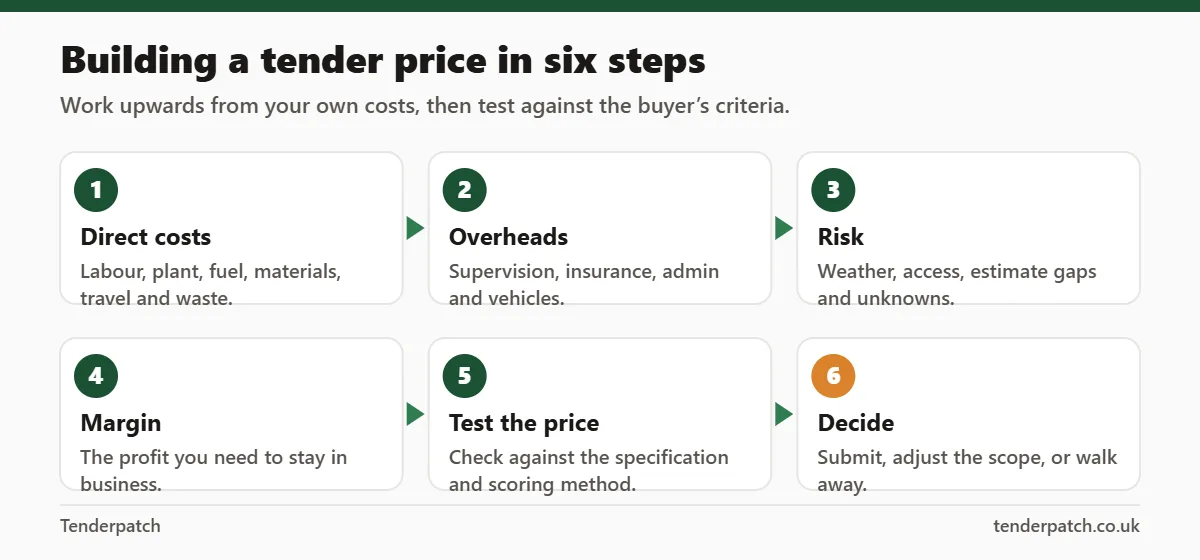
Start tender pricing with your real costs
Good tender pricing begins by listing every cost the specification creates before adding anything else.
- Labour. Wages, employer costs, holiday and sickness cover and supervision. The National Living Wage for workers aged 21 and over is £12.71 an hour from 1 April 2026, according to GOV.UK, and that is only the floor, not the cost of an employee to you.
- Plant and equipment. Fuel, repairs, depreciation, hire and replacement.
- Materials. Plants, seed, soil, stone and consumables, with supplier quotes where prices may move.
- Travel and mobilisation. Time between sites and the cost of getting crews and plant there.
- Waste. Disposal costs, licences and transport.
- Compliance. Insurance, training, personal protective equipment and any traffic management.
Overheads, risk and margin
Direct costs are not the whole price. Add a fair share of overheads such as management time, vehicles, premises, insurance and software. Then allow for risk: unclear quantities, weather, difficult access, and the possibility of extra visits. Finally, add a margin. If a price has no margin, you are working for nothing and carrying all the risk.
Weather, growth and seasonal risk
Grounds work is driven by the weather. A wet spring can double the workload without changing a fixed price, so allow for it as a separate risk line sized from your own records of lost days and extra visits, not buried in labour. Before you price a grass cutting or grounds maintenance contract, check three things in the specification: whether the number of cuts is fixed or triggered by grass height, who pays for extra visits, and whether a missed visit has to be made up and by when.
Test the same bid three ways, using figures from your own business. The table is a method, not a set of prices:
| Normal season | Wet season | Staff shortage | |
|---|---|---|---|
| Visits needed | As specified | As specified plus extra visits | As specified |
| Labour and travel hours | A | A plus extra | A plus agency or overtime |
| Total cost | C1 | C2 | C3 |
| Contract price (fixed) | P | P | P |
| Profit | P minus C1 | P minus C2 | P minus C3 |
If the wet-season or staff-shortage column loses money, you need a larger risk allowance, a pricing format that lets you charge for variations, or a decision not to bid. For the buyer-side view of cut frequencies, see our guide to grass cutting contracts.
A hypothetical worked example
The figures below are invented to show the method of tender pricing. They are not market rates and should not be used as a guide to price.
| Item (per visit) | Hypothetical amount |
|---|---|
| Labour: 3.5 operative hours at £18.00 loaded cost | £63.00 |
| Machinery and fuel | £14.00 |
| Travel and mobilisation | £9.00 |
| Waste handling | £4.00 |
| Direct cost per visit | £90.00 |
| Overheads at 12% of direct cost | £10.80 |
| Profit mark-up at 10% of direct cost plus overheads | £10.08 |
| Price per visit | £110.88 |
| 26 visits a season | £2,882.88 |
Mark-up and margin are not the same thing. In this hypothetical example the £10.08 profit is a 10% mark-up on a cost of £100.80, but only about 9.1% of the £110.88 price. Decide which one you use, and use it consistently when you compare bids or set a minimum acceptable profit.
Check that your own figures reconcile: add the direct costs, apply overheads, then the profit mark-up, then multiply by the number of visits. If the buyer’s price schedule asks for rates instead of a lump sum, break the price down in the way requested.
Want to spend less time searching for public-sector opportunities? Start your 14-day free trial. No card is needed and nothing is charged automatically.
Tender pricing by type of work
| Work | How buyers often ask for prices | Watch for |
|---|---|---|
| Grounds maintenance and grass cutting | A price per visit, per site or per year, plus rates for extra work | Number of cuts, small sites with high travel cost, arisings and litter |
| Landscaping and planting | A bill of quantities or schedule of rates | Plant sizes and supply, ground conditions, establishment and defects periods |
| Tree surgery and arboriculture | Day rates, job prices or a schedule of rates | Access, traffic management, emergency call-outs and disposal of timber |
If the work is split into lots, price the lot you can serve rather than the whole contract; the Cabinet Office’s guidance on lots explains how buyers can divide a requirement. Parish and town council work is often priced as a quote rather than a formal tender; see our guide to parish council grounds maintenance tenders.
How buyers score tender pricing
Read the scoring method carefully. The Cabinet Office’s guidance on assessing competitive tenders says relative scoring against the lowest-priced tender can negatively affect value for money, and that life-cycle cost should generally be used in assessment rather than initial purchase price except for basic purchases. In practice, buyers describe their own formulas, and your best option is to price honestly and then see how the formula treats your number.
Tender pricing: avoiding the underpricing trap
Before a buyer can disregard a tender as abnormally low, it must notify you and give you a reasonable opportunity to show that you can perform the contract at that price. Do not rely on that as a safety net. If you cannot explain your price in plain terms, it is probably too low.
- Never price below your own cost to win the first contract.
- Do not copy the previous holder’s price without understanding their cost base.
- Check that the contract term, variations and extensions allow you to recover cost increases.
Payment and cash flow
The Procurement Act implies a term that valid, undisputed invoices be paid within 30 days of receipt, or by a later due date stated on the invoice. See the electronic invoicing and payment guidance. The same payment terms are implied into relevant subcontracts, and into regulated below-threshold contracts. Include the cost of financing work in your tender pricing if payment is slower than your costs.
Pricing pitfalls by trade
- Grounds maintenance. Forgetting that a large number of small sites costs more than one large site of the same area, because of travel and set-up time.
- Landscaping. Pricing plants and materials from an old quote. Check validity and delivery costs, and allow for losses during establishment if the contract makes you responsible.
- Tree surgery. Under-pricing access, traffic management and timber disposal, and not allowing for emergency call-out arrangements where the specification requires them.
Term, extensions and price changes
A price that works for a one-year contract may not work over three. Check the term, extension options and any rule on price changes. Ask how rises in labour or fuel costs are handled, and whether prices are fixed or can be reviewed. If the contract does not allow price changes, include the likely cost movement in your price or decide whether the risk is acceptable.
Labour cost is the item most likely to move over a multi-year term. GOV.UK publishes the National Living Wage for workers aged 21 and over as £12.71 an hour from 1 April 2026, with £13.21 shown from April 2027 (GOV.UK rates). If the contract does not let you review prices, include the known increase in your price. Also budget insurance premiums from the contract start date: under the Procurement Act a buyer cannot require contract insurance to be in place before award, but it can require it from the start of the contract.
The Cabinet Office’s competitive tendering procedures guidance says negotiation is not available in the open procedure and, in a competitive flexible procedure, the tender notice must state the intention to negotiate and the elements open to negotiation. In practice, most price schedules are submitted as final, so treat your first number as the number.
A blank cost build-up worksheet
Copy this into a spreadsheet for each grounds maintenance, landscaping or tree contract you price. In the second column write how you worked each figure out; the amounts must come from your own records.
| Cost heading | How you worked it out | Amount per year |
|---|---|---|
| Labour on site | ||
| Travel and loading time | ||
| Supervision and admin | ||
| Plant and equipment (depreciation, repairs, consumables) | ||
| Vehicles and fuel | ||
| Waste disposal | ||
| Materials | ||
| Insurance and compliance | ||
| Weather and growth risk allowance | ||
| Total direct cost | ||
| Overheads share | ||
| Profit (state whether mark-up or margin) | ||
| Price | In the buyer’s format: per visit, per site, per area or lump sum |
Six checks before you submit the price
- Does every line in the pricing schedule have a figure, with no blanks?
- Do totals add up, and is VAT treated as the form instructs?
- Does the price match the resources in your method statement?
- Does it include travel, waste, supervision and compliance?
- Does it leave a margin that makes the contract worth winning?
- Could you explain every number if the buyer asked?
Frequently asked questions
How do I approach tender pricing?
Build the price from your direct costs, add overheads and risk, then add margin. Test the result against the specification, the scoring method and what you know about the buyer’s budget.
Should I price low to win?
Not below your own cost. A price you cannot deliver at can lose you money and damage your reputation, and abnormally low tenders can be investigated.
Do buyers publish their budget?
Sometimes, as an estimated value in the notice. Where it is stated, treat it as context, not a target.
Where can I find tender pricing information?
In the tender documents: the pricing schedule and any rates or quantities. Past contract award notices on Find a Tender can show what buyers paid.
How do I allow for weather when I price a grass cutting or grounds maintenance contract?
Add a separate risk allowance based on your own records of lost days and extra visits, check whether the specification fixes the number of cuts or triggers extra visits by grass height, and test your price in a wet-season and a staff-shortage scenario before you submit.
When you are ready to look for more tenders to price, see where to find UK public sector tenders and live grounds maintenance tenders.
Find tenders worth pricing
Pricing takes time, so choose bids carefully. Browse open grounds maintenance tenders without an account, or start a 14-day free trial (no card needed, nothing charged automatically) for a daily or weekly email when a new match appears. Tenderpatch draws on official notices, mainly from Find a Tender. It does not price work for you, and it does not cover contracts advertised only on council websites; its Scottish coverage is partial.
Browse open grounds maintenance tenders Start 14-day free trial
This guide is general information, not legal or procurement advice. Rules and thresholds change: check the official notice and current government guidance before you bid.