Grounds maintenance tenders are how councils and other public bodies buy grass cutting, parks and open-space care, verges, cemeteries, sports pitches and similar work. The work is often bundled into wider “parks”, “open spaces” or “estates” contracts, and buyers describe it in different words, so finding it takes a routine rather than a single search. This guide shows where grounds maintenance tenders are advertised, which words and classification codes to search, and how to screen a notice in a few minutes before you decide to bid.
Checked against official guidance on 30 October 2026. Tenderpatch is not a legal adviser: always rely on the official notice and documents before you bid.
In this guide
Where to search for grounds maintenance tenders
Start with Find a Tender for Procurement Act notices about council grounds maintenance tenders. Use Contracts Finder for supplementary and historical research, checking whether each result is still open. For Scottish work include Public Contracts Scotland; for Welsh work include Sell2Wales. Follow the buyer’s stated submission route.
For the differences between notice services and submission portals, see our UK tender search guide.
Who buys grounds maintenance
Councils are the obvious buyers, but not the only ones:
- Local authorities (district, borough, unitary and county councils): parks, verges, cemeteries, sports pitches and housing land.
- Housing providers and associations: communal grounds across many small sites, often split into lots by area.
- Schools, academy trusts, NHS sites and universities: campus or site grounds, sometimes inside a facilities contract.
- Parish and town councils: small, regular work that is often not on Find a Tender. See our guide to parish council grounds maintenance tenders.
Which of these appear on Find a Tender depends on the contract’s value and how the buyer chooses to advertise it.
Search with the words buyers use
Do not rely on “gardening” alone. Also try: grounds maintenance, grass cutting, verge maintenance, parks maintenance, cemetery maintenance, sports turf, horticultural services, hedge cutting and landscape maintenance. Run each term, because titles vary a great deal. For example, searching “grass cutting”, “grounds maintenance” and “parks maintenance” separately, then testing CPV code 77314000, catches notices that a single search misses. Deduplicate by notice reference, not by title.
Use the classification codes
Notices carry Common Procurement Vocabulary (CPV) codes, which describe what is being bought. Codes commonly relevant to this trade include 77310000 (planting and maintenance of green areas), 77313000 (parks maintenance) and 77314000 (grounds maintenance). For example, an official grounds maintenance framework notice uses 77314000. This is a historical example, not a live opportunity. Buyers do not always choose the code you would expect, so use codes and words together.
Rather than repeat the same council grounds maintenance tender searches every morning, you can have matching notices sent to you. Start your 14-day free trial. No card is needed and nothing is charged automatically.
Narrow by area and closing date
Filter to a workable delivery area, then check closing dates. A notice may use a regional code, postcode or free-text location; the buyer’s office is not necessarily the work site. Read the site schedule before assuming the contract is local. You can browse open grounds maintenance tenders by council area without an account.
Tender, contract or framework: what the wording means
Notices use three terms that matter to a small contractor:
- Tender or contract notice: an invitation to bid for a specific contract, usually with a closing date.
- Framework: an agreement that admits suppliers in advance, with individual jobs (call-offs) awarded under it. Being admitted is not the same as being given work. The Cabinet Office frameworks guidance explains how call-offs work.
- Planned procurement, pipeline or market engagement notice: a heads-up, not yet an invitation to bid.
Award notices show who won and for how long. Use them to work out when a contract is likely to be re-tendered, but do not treat them as open opportunities.
Look beyond the big councils
Parish and town councils often advertise smaller grounds contracts on their own websites or notice boards, sometimes as well as on the national services. Housing associations, schools and NHS sites also buy grounds services. Search by the name of the place as well as the type of work, because smaller buyers’ council grounds maintenance tenders are easy to miss.
Check the practical details before you invest time
- When does the contract start, and how long does it run, including any extensions?
- How many sites, and where?
- What insurance and health and safety evidence is asked for?
- How will bids be scored: price only, or price and quality?
Notices often leave some of these blank. If the notice does not say, the tender documents on the buyer’s portal usually do.
Requirements vary by contract
Look for the buyer’s evidence requirements on experience, staff competence, safe working, equipment, environmental practice and financial capacity. Do not assume that every one of the council grounds maintenance tenders you review requires the same turnover, insurance limit or accreditation. Under Procurement Act guidance, conditions of participation assess supplier capacity and ability and must be proportionate; the official guidance explains the limits. Check the regime stated in the notice, because rules differ between England, Wales, Scotland and Northern Ireland.
When pricing, include travel between sites, mobilisation, supervision, waste handling, machinery downtime and any specified service response. If volumes are estimates or the arrangement guarantees no work, reflect that in your assessment rather than treating the headline value as secured revenue.
Types of council grounds maintenance contract
“Grounds maintenance” covers a range of work, and councils package it in different ways. The table shows common patterns; the notice and specification decide what applies to a particular tender.
| Contract type | Typical scope (varies by buyer) | What to check |
|---|---|---|
| Parks and open spaces | Grass cutting, bed and shrub maintenance, litter and general care of green space | Number of sites, visit frequencies and seasonal peaks |
| Highway verges and amenity grass | Cutting and clearing of verges and landscaped areas | Traffic management needs and access arrangements |
| Cemeteries and churchyards | Grass and grave-area maintenance, sometimes with specialist tasks | Working around services and visitors; site-specific rules |
| Sports pitches and bowling greens | Turf care and line marking | Specialist equipment and technical standards in the specification |
| Housing land and communal areas | Routine maintenance across many small sites | Lots by area, response times and resident contact |
| Multi-service estates contracts | Grounds work bundled with other services | Whether a grounds lot can be bid for separately |
Eligibility and bidding considerations
Whether you can bid depends on the individual tender, not on a universal rule for councils. Before you invest time, work through these points:
- Scope and area: can your crews cover every site, or only one lot, and is a lot-by-lot bid allowed?
- Capacity: do you have the people, vehicles and machinery to meet the visit frequencies in peak season?
- Evidence: can you show comparable work, insurance and safe-working procedures as requested?
- Contract length and payment: check the term, extension options and invoicing arrangements stated in the documents.
- Scoring: work out whether quality, price or social value will decide the result, then judge whether your evidence is strong enough.
Worked example: screening one notice
This example is hypothetical. A contractor sees a notice for grounds maintenance across a council’s parks, split into three geographic lots. The firm’s base is close to one lot, so it reads that lot’s site schedule and finds forty sites with fortnightly cuts from April to September. It counts the crew-days this needs, adds travel, waste disposal and mobilisation, and compares the result with the price-quality weighting in the award criteria. If the margin looks too thin or the response times cannot be met, it records a no-bid and moves on. If the numbers work, it registers on the buyer’s portal, downloads the documents and raises any clarification question before the stated deadline.
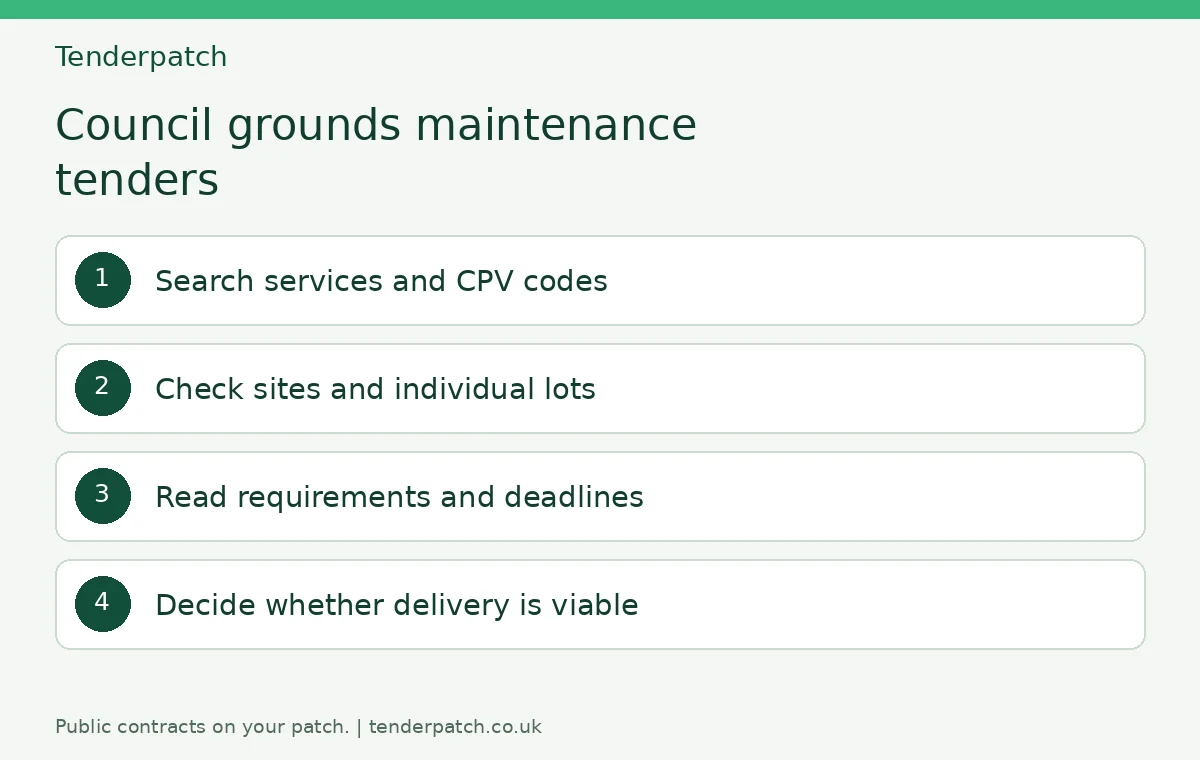
Use the same order every time:
- Record the notice reference, buyer and submission portal.
- Check the actual sites, visit frequencies and seasonal workload.
- Read the lot rules and whether you may bid for one lot.
- Record clarification and submission deadlines, including times.
- Download the current specification, pricing schedule and contract terms.
- Decide whether capacity and likely margin justify preparing a bid.
Keep broad results long enough to check lots: a large multi-service contract may contain a smaller grounds lot, while a title mentioning grounds may actually concern equipment hire. Spending an hour on this screen is cheaper than writing half a bid for a contract you cannot deliver.
Frequently asked questions
Can a small grounds contractor bid?
Potentially, if it can meet the stated requirements and deliver the relevant contract or lot. Size alone does not establish suitability. Check the documents and ask a clarification through the authorised portal if a requirement is unclear.
Does joining a framework guarantee work?
No. Read how work is allocated and whether further competition is required. Framework admission and winning an individual call-off are different stages.
Do councils always advertise grounds maintenance contracts on Find a Tender?
Not always. Below-threshold rules, devolved procurement regimes and local practice all matter, so check Find a Tender, the relevant national portal and the council’s own procurement page.
What is the difference between a tender, a contract and a framework?
A tender is the invitation to bid, the contract is what is awarded, and a framework is an agreement that lets suppliers be called on later for individual jobs. Admission to a framework is not a guarantee of work.
What is the difference between grounds maintenance and landscaping tenders?
Grounds maintenance is mainly the ongoing care of existing green space, while landscaping usually involves creating or changing features. Notices often mix the two, so read the specification rather than the title. Our landscaping tenders guide explains the difference.
How many search terms should I use?
Use several, because buyers describe the same work in different ways. Combine words such as “grounds maintenance”, “grass cutting” and “parks maintenance” with classification codes, then deduplicate by notice reference.
Where to go next
If you are pricing a specific trade, read our guide to grass cutting contracts. If you are still choosing where to look, read the UK tender search guide. You can also see which industries Tenderpatch covers, review the features or read how Tenderpatch works. The pricing page lists current plans. Always rely on the official notice and documents for the final bid decision.
See open grounds maintenance tenders on your patch
Browse today’s open grounds maintenance notices without an account, or start a 14-day free trial (no card needed, nothing charged automatically) to get a daily or weekly email when a new match appears and flags when the closing date changes or a tender is cancelled on tenders you follow. Tenderpatch draws on official notices, mainly from Find a Tender. It does not cover contracts advertised only on council or parish websites, and its Scottish coverage is partial, so check Public Contracts Scotland directly for Scottish work.
Browse open grounds maintenance tenders Start 14-day free trial
This guide is general information, not legal or procurement advice. Rules and thresholds change: check the official notice and current government guidance before you bid.