Find tree surgery tenders by searching for arboricultural services, tree management and related work as well as “tree surgery”. Opportunities may be stand-alone contracts, lots within grounds maintenance procurements or contracts awarded under frameworks. Check the scope and delivery sites before deciding which route suits your business, and treat each of the tree surgery tenders you find as a separate screening exercise.
Checked against official guidance on 30 October 2026. Tenderpatch is not a legal adviser: always rely on the official notice and documents before you bid.
In this guide
Where to find tree surgery tenders
Search Find a Tender for relevant notices. Include Public Contracts Scotland for Scottish work and Sell2Wales for Welsh opportunities. The buyer’s linked portal normally provides documents, clarifications and submission instructions. A published award is market intelligence, not an open invitation to bid.
Our UK public tender portal guide explains which national services to include and how notice searches differ from bid submission.
Words that find tree contracts
Try: tree works, tree surgery, arboricultural services, tree inspection, tree survey, tree management, tree felling, stump grinding and emergency tree work. Buyers use different terminology, so do not rely on one phrase when searching for tree surgery tenders.
Codes that describe the work
Relevant Common Procurement Vocabulary (CPV) codes include 77211400 (tree-cutting services), 77211500 (tree-maintenance services) and 77340000 (tree pruning and hedge trimming). These codes appear in an official grounds maintenance framework notice. That historical example illustrates classification, not a currently open opportunity. Notices may use broader horticultural codes, so search by words too.
Instead of repeating tree surgery tender searches every day, you can have matching notices sent to you. Start your 14-day free trial. No card is needed and nothing is charged automatically.
Watch for lots inside larger contracts
A multi-lot notice for housing repairs, highways or parks may include a tree lot that is easy to miss if you only read the title. Open the notice and check the lots, and bid for the lot that suits you if the buyer allows it. Housing and parks contracts often bundle tree work with grass cutting and other grounds services; our guides to grounds maintenance tenders and landscaping tenders show how to screen those notices.
Frameworks and call-offs
A framework is an agreement that sets terms for work the buyer may order later, often from several suppliers. The value shown usually covers the whole agreement, not one job. Direct call-off opportunities generally concern suppliers on the relevant framework. Check whether the arrangement is an open framework with scheduled reopening opportunities; do not assume it can be joined at any time. See the official framework guidance. Admission does not guarantee orders. Ask how call-offs are allocated (for example by rank order, rotation or a further competition) and when the agreement ends, because the end date tells you when the next tender is likely.
What buyers commonly ask to see
- Relevant qualifications and competence of the team.
- Insurance cover appropriate to the contract.
- Health and safety policies and method statements for high-risk work.
- How you will handle emergencies, such as storm damage.
The exact requirements are in each tender’s documents, so read them before you decide to bid on any of these tree surgery tenders.
Separate inspection work from operational tree work
A tree survey contract may require inspection expertise and reporting rather than a climbing or felling crew. Conversely, operational work may include traffic management, disposal, access constraints and emergency call-outs. Read the specification for each lot and identify what you can deliver directly, what needs a specialist partner and what falls outside your capability.
A practical opportunity review
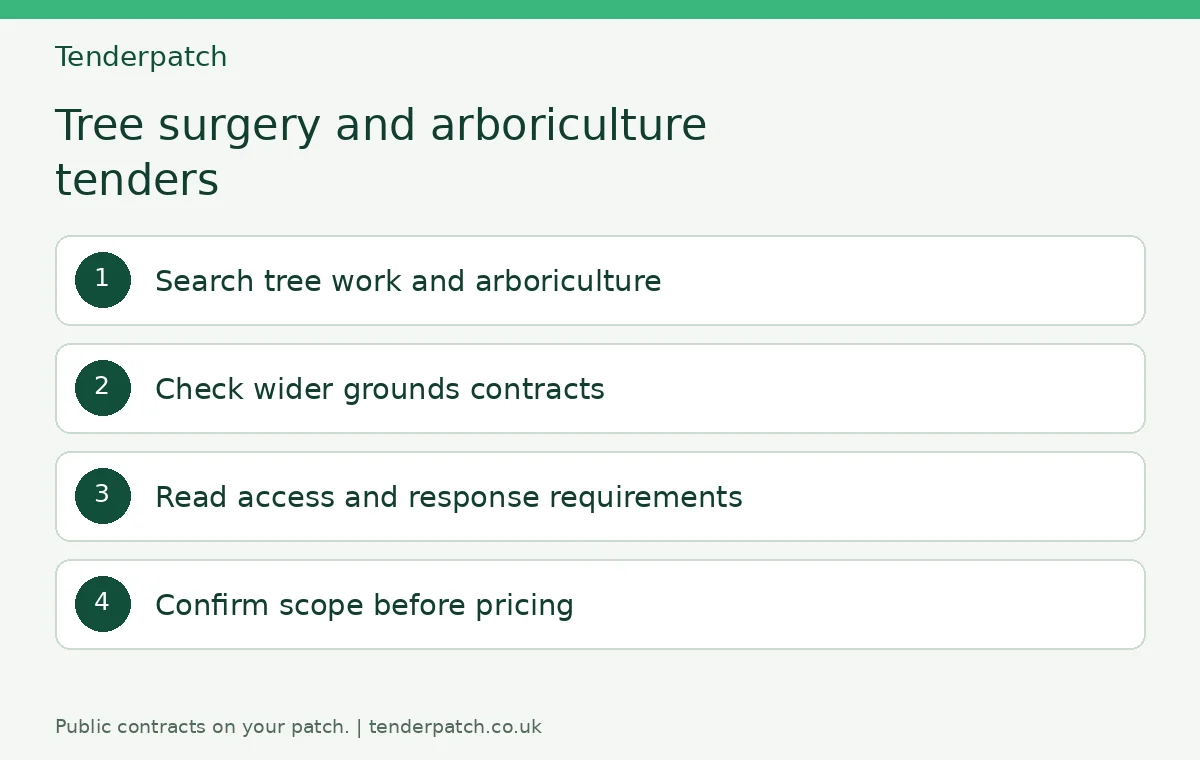
- Confirm that the notice is inviting participation and record the latest deadline.
- Map the actual work sites and any out-of-hours response requirement.
- Check estimated workload, seasonal peaks and whether minimum orders are guaranteed.
- Review competence, equipment, safe-working and insurance requirements.
- Price mobilisation, supervision, access, waste handling and contingency.
- Check that the operators you would name hold the certificates asked for, and that your risk assessments, method statements and aerial rescue arrangements are ready to adapt.
- Read award criteria and decide whether your evidence answers the buyer’s questions.
For example, a nearby council’s contract can still be unsuitable if it requires emergency coverage across a much wider area. A smaller geographic lot may fit better, provided the buyer permits bids for that lot and your team meets its requirements.
Qualifications and evidence buyers may ask for
There is no single qualification rule for every tree contract. Buyers set requirements to suit the work, and under Procurement Act guidance they should be proportionate to the contract (the official conditions-of-participation guidance explains the principle). Typical areas include:
| Area | Examples a buyer might request | Note |
|---|---|---|
| Competence | Training and certificates for chainsaw use, aerial work and rescue, matched to the tasks in the specification | Ask which evidence or equivalent is acceptable if the wording is unclear |
| Safe working | Risk assessments, method statements and lone-working arrangements. The HSE tree work guidance describes the main hazards | Expect more detail for high-risk or roadside work |
| Accreditation | Some buyers refer to schemes such as the Arboricultural Association’s Approved Contractor scheme. Others do not | Not compulsory in every tender; check the documents |
| Standards | References to recognised tree work standards, where the specification cites them | Only relevant if the tender names them |
| Insurance | Public liability and employer’s liability at the levels in the tender | Levels vary by contract |
Two points from the Procurement Act guidance help smaller firms: a buyer cannot require a particular qualification without allowing equivalents, and it cannot require contract insurance to be in place before award, although it can require it from the start of the contract (see the conditions of participation guidance above).
Permissions: protected trees, conservation areas and felling licences
Tree work can need permission before anyone starts cutting, and the specification should say who checks. In England, trees protected by a Tree Preservation Order, and trees in a conservation area, generally need the local planning authority’s consent or notice before certain work; for conservation areas the notice period is six weeks unless an exception applies (see the GOV.UK guidance on tree preservation orders and trees in conservation areas). Larger-scale felling can also need a Forestry Commission felling licence in England, with exceptions (GOV.UK: when a felling licence is needed). The rules differ in Scotland, Wales and Northern Ireland.
For a bid, the practical questions are: does the buyer arrange consents and tell you which trees are protected, or are you expected to check? Is the programme realistic if a notice period applies? Who carries the cost if a consent is delayed or refused? Ask a clarification question when the documents are silent.
Bidding considerations for tree work
- Emergency response: some contracts require out-of-hours cover after storms. Check the response times and the area they cover.
- Access and traffic management: roadside, school and cemetery sites often add cost. Decide who provides traffic management.
- Arisings and disposal: establish whether timber and brash must be removed or can be left, chipped or sold.
- Protected trees and constraints: see the permissions section above. If the specification does not say who checks tree preservation orders, conservation areas or licences, ask.
- Schedule of rates: many tree contracts price by task. Test whether the rates cover realistic jobs rather than only the cheapest items. Check how the bands are measured (for example by height or stem diameter), what each rate includes (chipping, traffic management, clearance) and how work that falls between bands is valued.
Worked example: a tree lot inside an estates contract
This example is hypothetical. A housing provider advertises an estates contract with four lots: grounds maintenance, tree works, fencing and hard landscaping. A tree firm that does not offer the other services checks whether it may bid for the tree lot alone. The notice allows bids for individual lots, so the firm reads the tree lot’s schedule of rates and emergency response clause, confirms its insurance and competence evidence, and prices a sample of typical jobs. It finds the out-of-hours cover area too wide for its crew base, so it decides whether a partner or a clarification question could solve that before committing.
Frequently asked questions
Can I bid with a subcontractor?
Check the notice and documents for subcontracting rules, declarations and evidence. Identify responsibilities clearly and confirm the partner’s availability before relying on its capacity.
Must I hold a particular accreditation?
Not necessarily. Requirements vary by contract: some buyers refer to an accreditation scheme or named standards, others ask for equivalent evidence, and under Procurement Act guidance a buyer cannot require a particular qualification without allowing equivalents. Use the actual tender requirements, and ask through the stated clarification channel if the acceptable evidence is unclear.
Is the headline framework value my potential revenue?
No. It may cover several suppliers, lots and years. Read the allocation process and estimated volumes; build your assessment around realistic work and margin.
Where do tree surgery contracts appear?
Search Find a Tender and the relevant national portal, and check lots inside wider grounds, highways and housing contracts. Councils may also use their own portals.
Do I need permission to work on protected trees?
Often, yes. In England, trees with a Tree Preservation Order or in a conservation area generally need consent or notice first, and some felling needs a licence. The tender documents should say who checks; if they do not, ask. The rules differ in Scotland, Wales and Northern Ireland.
Where to go next
Tree work is often found alongside wider estates contracts, so read our guide to finding UK public sector tenders first if you are choosing portals. You can also see which industries Tenderpatch covers, browse open tree surgery tenders, review the features, or read how Tenderpatch works. See the pricing page for current plans. Verify every one of your tree surgery tenders against the official documents.
See open tree surgery tenders on your patch
Browse open tree surgery and arboriculture tenders without an account, or start a 14-day free trial (no card needed, nothing charged automatically) for a daily or weekly email when a new match appears, with flags when a closing date changes on tenders you follow. Tenderpatch draws on official notices, mainly from Find a Tender. It does not cover contracts advertised only on council websites, and its Scottish coverage is partial.
This guide is general information, not legal or procurement advice. Rules and thresholds change: check the official notice and current government guidance before you bid.