
Grass cutting contracts are among the most common pieces of grounds work that councils put out to tender. Most are advertised as part of wider grounds maintenance, so the successful bidders are usually businesses that read the specification closely, price travel and weather honestly, and answer the quality questions as carefully as the price schedule.
Checked against official guidance on 30 October 2026. Tenderpatch is not a legal adviser: always rely on the official notice and documents before you bid.
In this guide
What councils want from grass cutting contracts
A council’s grass cutting requirement is rarely only “cut the grass”. A typical specification covers highway verges, parks, housing land, cemeteries and sports grounds, with different standards for each. It may set cutting heights, frequencies per season, edging and strimming, litter removal before cutting and what happens to the arisings.
Buyers also care about reliability, safe working and communication. A reliable record in nearby public work can help, but the Procurement Act guidance on conditions of participation says buyers cannot require experience with a specific authority. Public sector experience can be asked for in general terms.
Where to find grass cutting contracts
Many grass cutting contracts are not labelled with those words. Searching only for “grass cutting contracts” can miss larger grounds maintenance notices where cutting is one lot or one line of the specification. Use a spread of terms, including “council grass cutting”, and check lots.
| Where to look | Search terms to try | Watch out for |
|---|---|---|
| Find a Tender | “grass cutting”, “grounds maintenance”, “verge maintenance”, “open space”. Find a Tender is free to search. | Notice type, closing date and whether the work is split into lots |
| Council websites | “tenders”, “supplier”, “contracts register” | Contracts below the notice values may be advertised only locally |
| Parish and town councils | Ask the clerk for a supplier list | Small value, repeat work, own standing orders. See our guide to parish council grounds maintenance tenders |
| Pipeline and planned notices | Future contracts, re-tenders and renewal dates | A future notice is not an invitation to bid yet |
Contract end dates are useful. If a council awarded a three-year contract, it will normally re-tender before it ends, so notice of what is coming can help you plan. Award notices on Find a Tender show who won and the term. They are market intelligence, not live invitations. For the wider picture, see our guide to grounds maintenance tenders.
Searching several portals for grass cutting contracts takes time. Start your 14-day free trial. No card is needed and nothing is charged automatically.
Reading the specification
Before pricing, extract these items. They are where grass cutting contracts are won or lost:
- Schedule and frequency. Number of cuts in each season, and what happens if growth outpaces the schedule.
- Site list and areas. Measured areas or plans. If areas are approximate, ask a clarification question.
- Standards of finish. Height of cut, edging, clearance of arisings and inspection method.
- Variations. How extra visits, extra sites and one-off jobs are priced.
- Contract term and extensions. Initial term, possible extensions and termination rights.
- Payment. Invoicing frequency, payment terms and any deductions for failed standards.
Check whether the work is divided into lots. The Cabinet Office’s guidance on lots explains how buyers can split contracts, which may let a smaller business bid for one geographic lot rather than the whole contract.
Cut frequencies and the growing season
Specifications usually set a number of cuts per year, often more in the growing season than in winter, and sometimes a maximum grass height that triggers an extra visit. Before pricing, write down the cuts per site per season, the trigger height, whether extra cuts in a wet spring are included or priced as variations, and who decides. The table is illustrative only, to show the structure of a specification, not typical figures:
| Site type (example) | Frequency in a specification (example) | Season (example) | What to ask |
|---|---|---|---|
| Amenity grass | Every two weeks | April to September | Is a missed cut after rain made up, and by when? |
| Verge | Four cuts a year | April to October | Who provides and pays for traffic management? |
| Sports pitch | Weekly in season | March to October | What standard of finish and line marking is required? |
Verges and highways
Verge and highway cutting adds safety requirements: traffic management, signing and working near live carriageways, and sometimes particular operator qualifications. Check whether traffic management is priced separately or included, who supplies it, and what the buyer expects for litter clearance before cutting. The land beside a road may be managed by a different authority from the one issuing the tender, so confirm which sections the contract covers.
Sports pitches and playing fields
Pitch work is often a separate lot or specification, with standards for height, striping, line marking and renovation. If the document refers to a technical standard, read it before you price; do not assume your general mowing equipment is enough.
Pricing grass cutting contracts
Price from your own costs, not from the previous holder’s rate. Include everything that makes a visit possible, including the unproductive time moving between sites.
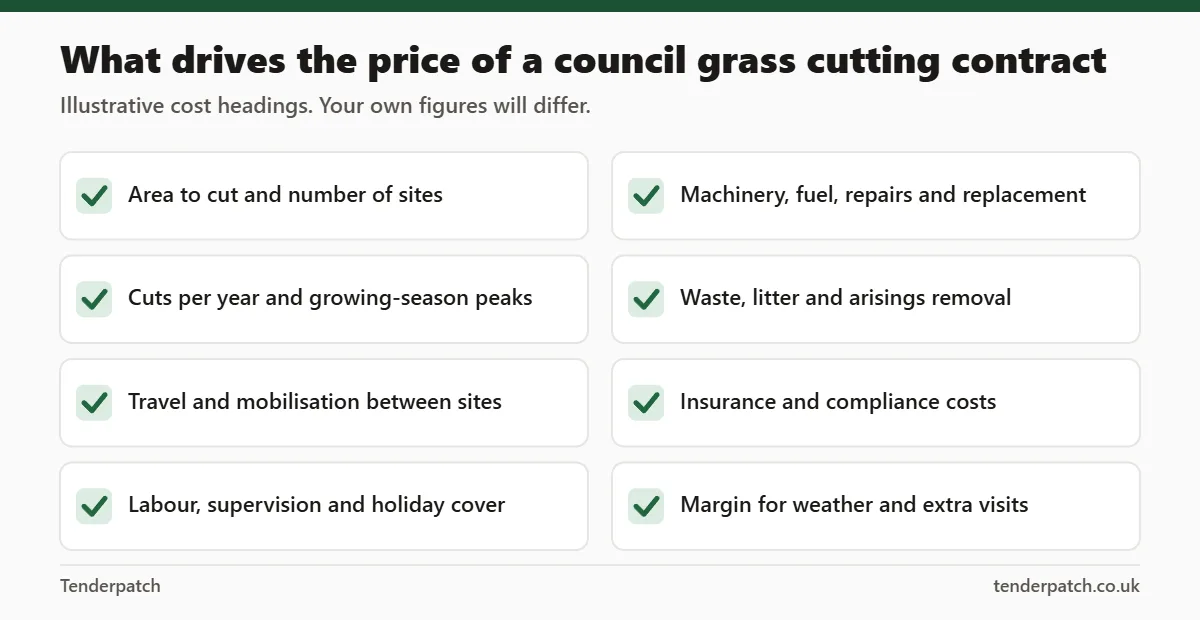
Labour is the largest single cost for most grounds businesses. The National Living Wage for workers aged 21 and over is £12.71 an hour from 1 April 2026, according to GOV.UK, and your actual wage bill will include employer costs and cover for holidays and sickness. Weather can move your schedule, so a fixed price needs a margin for catching up.
Be careful about pricing far below the market to win. Under the Procurement Act, a buyer that considers a price abnormally low must notify the supplier and give a reasonable opportunity to show it can deliver at that price before disregarding the tender, and a price you cannot sustain will hurt you if you win. The guidance on assessing competitive tenders explains how this works.
Peak-season capacity and the quality questions
Many councils score quality and price together. The Act requires the contract to be awarded to the most advantageous tender, which means the one that best meets the published award criteria, not automatically the lowest price. Read how the buyer will score you and answer each question directly.
Buyers want to know you can cover the busiest weeks, not the average ones. Evidence beats claims:
- Use your own equipment, crew sizes and routes as evidence. A rota and a machine list show more than a promise.
- Explain how you will cover sickness, breakdowns and wet weather, and how you will re-plan after rain.
- Describe safe working, including traffic management on verges where relevant.
- Say how you will communicate with the council, report delays and handle complaints.
- Give genuine, checkable references.
After you win: running a council grass cutting contract
Winning is the start of the work. A grass cutting contract is usually managed through inspections, a schedule of visits and a monthly or four-weekly invoice, so set up your own records from day one.
- Keep visit records. Dated photographs, crew sheets and notes on weather delays make disputes easy to settle.
- Report problems early. Tell the contract manager about blocked access, damaged equipment or unsafe sites before they become failures.
- Invoice correctly. The Procurement Act implies a term that valid, undisputed invoices are paid within 30 days, or by a later due date stated on the invoice. The payment guidance explains what counts as a valid invoice, so include the sum, a description of the work and a unique invoice number.
- Watch the term. Diarise the end date and any extension options, because the buyer’s next tender may be published well before the contract finishes.
Good delivery on one contract is a reference for the next. It also makes your quality answers more convincing, because you can describe a real routine rather than a plan.
Common mistakes
- Pricing the headline area but missing small sites that cost as much travel as large ones.
- Not asking about the growing-season frequency.
- Leaving out waste and arisings disposal.
- Ignoring the lots and bidding for a package you cannot service.
- Submitting late through the wrong channel. Always follow the buyer’s instructions.
Frequently asked questions
Are grass cutting contracts advertised publicly?
Many are, but not all. Larger councils often advertise grounds maintenance on Find a Tender, while small local contracts can be advertised on a council’s own site or offered to invited suppliers. Check each buyer.
Can a small business win council grass cutting contracts?
Yes, if it meets the stated requirements. Smaller contracts and lots can suit local businesses, but the buyer decides based on its published criteria.
How far in advance do councils tender?
There is no single answer. A council’s contracts register and pipeline notices can show when current contracts end, which helps you prepare.
Does Tenderpatch cover grass cutting contracts?
Tenderpatch matches official notices, mainly from Find a Tender, for grounds maintenance, landscaping, arboriculture and tree surgery, and shows why each one was matched. Grass cutting usually appears inside grounds maintenance notices. It does not cover contracts published only on council websites.
Grass cutting contracts reward preparation. If you are also pursuing larger grounds work, read where to find UK public sector tenders and browse live grounds maintenance tenders. If you also do planting or construction-style work, see our guide to landscaping tenders.
Set up a grass cutting search
Grass cutting is usually part of a grounds maintenance notice, so browse open grounds maintenance tenders first. If you want it done for you, start a 14-day free trial (no card needed, nothing charged automatically), save a search for “grass cutting” in your area, and get an email when a new match is published. Tenderpatch does not cover contracts advertised only on council websites, and its Scottish coverage is partial.
This guide is general information, not legal or procurement advice. Rules and thresholds change: check the official notice and current government guidance before you bid.