
Landscaping tenders cover everything from planting a verge to rebuilding a public square, and the word “landscaping” on a notice does not tell you which. Buyers also split work into maintenance and capital works, and the two are bid for in very different ways. This guide helps UK landscapers find landscaping tenders, read them and decide where to spend bid time.
Checked against official guidance on 30 October 2026. Tenderpatch is not a legal adviser: always rely on the official notice and documents before you bid.
In this guide
What counts as a landscaping tender
Buyers use the word broadly. Look for the substance.
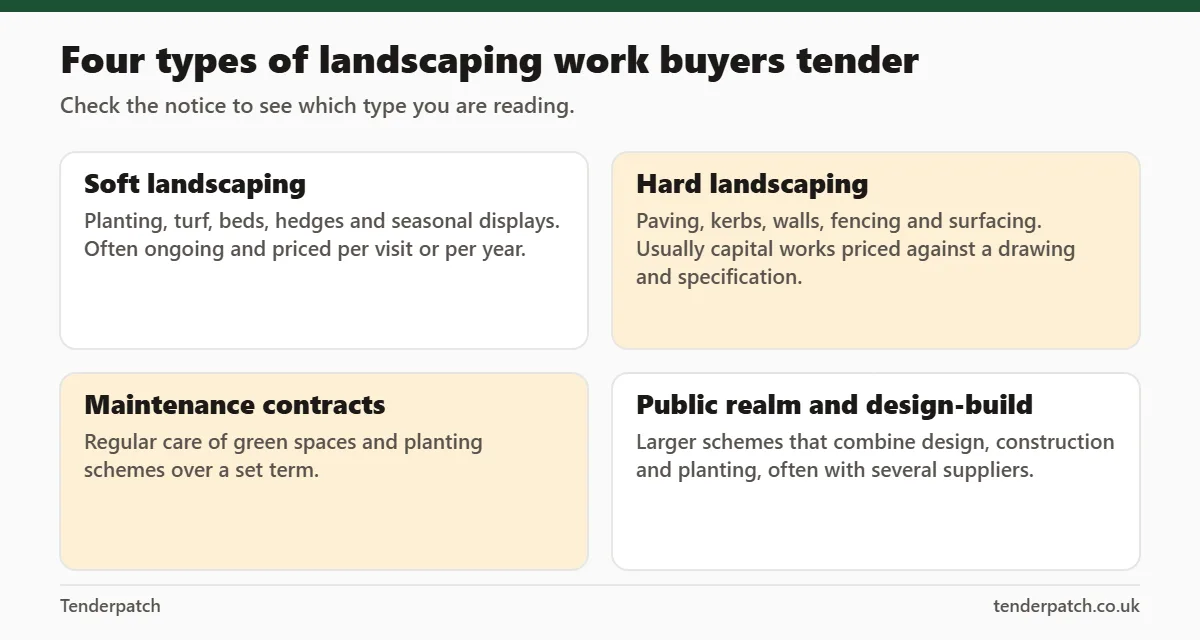
Soft landscaping is planting and turf, hard landscaping is paving and structures, and maintenance contracts are regular care over a term. Larger schemes can mix all three. Tenderpatch’s landscaping category covers planting, hard and soft landscaping and public realm works, so you can see how notices are grouped before you search elsewhere.
Capital works or maintenance?
| Capital landscaping (works) | Landscape maintenance (services) | |
|---|---|---|
| What it is | Creating or changing features: planting schemes, paving, play areas, public realm | Regular care of existing planting, beds, trees and grass over a term |
| How it is usually priced | From drawings, quantities and a programme | Per visit, per site or per period, often against a schedule of rates |
| Main risks | Materials, programme, ground conditions, defects period | Weather, frequency, response times, labour cost |
| Read first | Specification, drawings, programme | Site list, frequencies, standards of finish |
| Words in the notice | “works”, “external works”, “public realm” | “grounds maintenance”, “landscape maintenance” |
Many notices combine the two. Read the specification, not the title, and do not price a works scheme as if it were a maintenance round.
Where councils advertise landscaping tenders
- Find a Tender carries notices under the Procurement Act, including larger landscaping and public realm schemes. It is free to search.
- Council websites often list smaller quotes and works packages.
- Housing associations, universities and other public bodies publish through their own portals or through Find a Tender.
- Framework call-offs can restrict competition to suppliers already admitted. The Cabinet Office guidance on frameworks explains how call-offs are awarded.
Search for wording buyers actually use: “landscaping”, “soft landscaping”, “external works”, “public realm”, “planting”, “grounds” and “green space”. Use a notice’s lots and title to judge whether it fits your business. Tenderpatch’s landscaping tenders page shows how matching notices are presented.
Looking for landscaping contract opportunities without repeating every search? Start your 14-day free trial. No card is needed and nothing is charged automatically.
Works, services and value
Whether a notice is a “works” contract or a “services” contract changes which values and rules apply. Under the Procurement Act thresholds applicable from 1 January 2026, the GOV.UK thresholds guidance gives £5,193,000 including VAT for a works contract. Most landscaping tenders for smaller businesses will fall well below that, which means the below-threshold rules can apply instead. Under those rules, the below-threshold guidance sets notice values of £12,000 including VAT for central government authorities and £30,000 for other contracting authorities. Devolved regimes differ, so check the notice for the rules that apply.
You do not need to memorise these. What matters is that a lower value does not mean “not advertised”, and a higher value does not mean “you cannot bid”. Check the notice and the tender documents.
Landscape maintenance tenders
Landscape maintenance is a recurring service rather than a one-off scheme. Typical scope includes bed and shrub maintenance, weeding, pruning, litter, seasonal planting changes and establishment care after a new scheme. Price it like a service: see our guides to grass cutting contracts and grounds maintenance tenders, and read how the buyer wants extras and replacement planting handled.
What to check in the documents
- Specification and drawings. Quantities, species, materials, finishes and who supplies what.
- Programme. Start dates, planting seasons and any constraints on when work can happen.
- Maintenance and defects period. How long you are responsible for establishing planting.
- Insurance. Under the Procurement Act, a buyer cannot require insurance for performing the contract to be in place before award, though it can require it from the start of the contract. See the conditions of participation guidance.
- Qualifications and standards. A buyer cannot require a particular qualification without accepting equivalents.
- Pre-qualification schemes. For works, the guidance says industry pre-qualification tools can be used if they comply with the Act.
- Award criteria. How quality, price and any wider benefits will be scored.
A practical approach for small landscapers
Do not chase every landscaping tender. Decide first which kinds of work you can deliver profitably, then watch for those.
- Pick one or two work types, for example maintenance contracts and small planting schemes.
- Define the area you can serve without losing time on travel.
- Keep a library of method statements, risk assessments, references and photographs ready to adapt.
- Build relationships with the councils whose work suits you. Pipeline and planned notices can show what is coming.
- Consider subcontracting to larger contractors where your skill is specialist. Read each subcontract carefully.
Planting windows and the bid timetable
Landscaping is seasonal, and the tender timetable may not respect that. Plant material, turf and some surfacing work have natural windows, so a programme that starts in the wrong month can force a buyer to adjust or you to price in extra risk.
The time periods guidance says a minimum tendering period of 25 days can apply to an open procedure where tenders are submitted electronically and all documents are provided with the notice. It rises to 30 or 35 days where documents or submission are non-electronic or incomplete. A competitive flexible procedure can also include a separate participation period of at least 25 days. These are minimums, so read the deadlines in each notice rather than assuming a standard period.
Illustration only, not a rule: a notice is published on 1 September, closes on 6 October and is expected to be awarded in November. If the scheme includes bare-root planting, which generally takes place in the dormant season, a November award leaves a short window. Ask in a clarification question whether the programme will move if the award is later than planned.
Work back from the closing date:
- Read the documents in the first few days and decide whether to bid.
- Raise clarification questions as early as the buyer allows.
- Get supplier quotes for plants, stone, paving and plant hire while prices are still valid.
- Draft method statements while the site visit is fresh.
- Finish and check the submission at least a day before the deadline, in case the portal rejects a file.
After submission, buyers must provide an assessment summary to suppliers whose tenders were assessed, before publishing the contract award notice, and a standstill period of at least eight working days normally follows the award notice. See the standstill guidance. The summary tells you how you scored, which helps with the next bid.
Common mistakes
- Bidding for capital works with maintenance-style pricing, or the other way round.
- Ignoring seasonal planting windows that make the programme impossible.
- Not checking who supplies plants, topsoil and materials.
- Missing the clarification deadline when drawings and the schedule disagree.
- Treating an award notice as a live invitation to bid.
Frequently asked questions
Where can I find landscaping tenders?
Search Find a Tender, council websites and the portals named in each buyer’s notice. An alert for landscaping tenders in your area saves repeating the search.
Are landscaping tenders only for large companies?
No. Maintenance contracts, small works packages and subcontract work can suit smaller landscapers. Check the stated requirements and lots.
Do landscaping tenders need specific accreditations?
Requirements vary. Buyers can ask for relevant standards but must accept equivalents. Read each tender’s conditions of participation.
What is the difference between a landscaping tender and a grounds maintenance tender?
A landscaping tender may create or change features (capital works) or cover maintenance. A grounds maintenance tender is mainly the ongoing care of existing green space. Notices often mix them, so read the specification.
Does Tenderpatch cover landscaping tenders?
Yes. Tenderpatch has a landscaping category covering planting, hard and soft landscaping and public realm works, from official notices, mainly Find a Tender. It does not cover contracts published only on council websites.
For a wider look at finding opportunities, read where to find UK public sector tenders and explore the trades Tenderpatch covers.
See open landscaping tenders
Tenderpatch reads official notices, mainly from Find a Tender, for landscaping, grounds maintenance, arboriculture and tree surgery. Browse open landscaping tenders without an account, or start a 14-day free trial (no card needed, nothing charged automatically) for email alerts when a new match appears. Not covered: contracts advertised only on council websites. Scottish coverage is partial.
This guide is general information, not legal or procurement advice. Rules and thresholds change: check the official notice and current government guidance before you bid.