
A dynamic purchasing system (DPS) is a list of qualified suppliers that a buyer can use to run mini-competitions for contracts, and it stays open for new suppliers to join. Under the Procurement Act 2023 the DPS has been replaced by a broader tool called a dynamic market. If you do work that councils buy repeatedly, joining the right one can be a useful way in.
Checked against official guidance on 23 October 2026. Tenderpatch is not a legal adviser: always rely on the official notice and documents before you bid.
In this guide
What a dynamic purchasing system is
Under the older rules, a DPS was an electronic system buyers used for commonly available purchases. Suppliers who met the conditions could be admitted, and the buyer then invited admitted suppliers to bid for individual contracts. Some buyers still use DPSs set up under those rules, and Find a Tender lists them in its Commercial tools section alongside frameworks and dynamic markets.
What changed under the Procurement Act
The Cabinet Office’s dynamic markets guidance says the Act replaces dynamic purchasing systems and qualification systems with a single commercial tool, the dynamic market. Key differences from the old DPS:
- A dynamic market is a list of qualified suppliers that can be used for future procurements and it must remain open to new suppliers to join at any time.
- Its scope is wider: any procurement can now be run through one, not only commonly available purchases.
- It may be split into parts, and suppliers qualify only for the parts they join.
- Concession contracts are generally outside it, unless they are also utilities contracts.
So when a notice talks about a dynamic purchasing system, check whether it was established under the older regime or whether it is a dynamic market under the Act, because the rules differ.
How to join a dynamic market
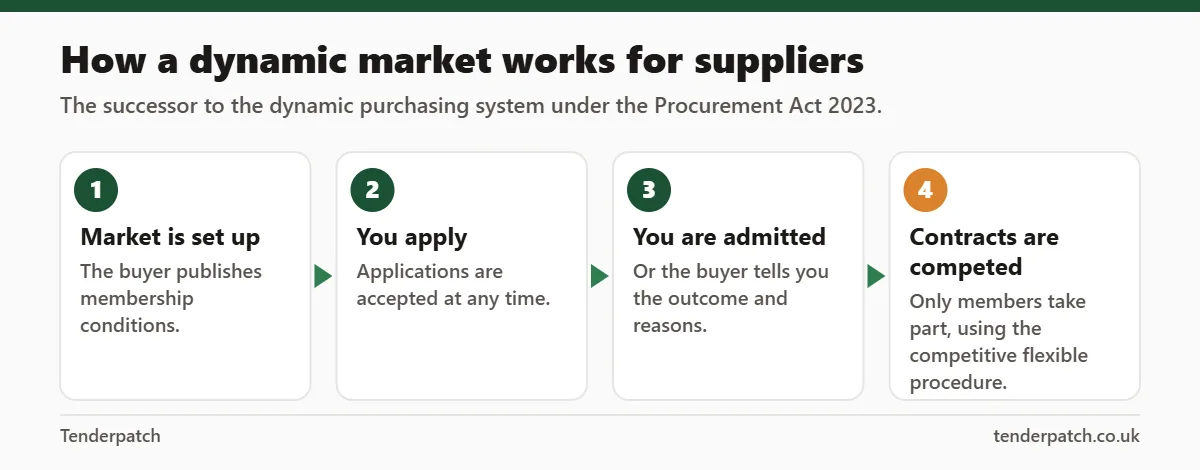
The guidance sets out how admission works:
- Conditions of membership. These are similar to conditions of participation and must be proportionate. A buyer cannot require audited accounts from a supplier not required to have them, cannot require contract insurance before award, and cannot require you to have held a contract with a particular authority.
- Evidence. Buyers can require third-party verifiable evidence, for example an ISO certification, and must accept equivalent qualifications.
- Applying. Applications are accepted at any time and considered within a reasonable period.
- Outcome. The buyer tells you the result and the reasons. Eligible suppliers are admitted as soon as reasonably practicable.
- Staying in. Removal is mandatory if you are excluded under the relevant grounds and discretionary if you stop meeting the conditions. You must be told before removal and may reapply.
The number of members cannot be capped, and the conditions cannot change during the life of the market. A fee can be charged only to a supplier awarded a contract, as a fixed percentage of the estimated contract value, not for membership.
Looking for a more focused way to follow relevant opportunities? Start your 14-day free trial. No card is needed and nothing is charged automatically.
How contracts are awarded
Contracts from a dynamic market must be awarded using the competitive flexible procedure. The open procedure and direct award cannot be used. Only members can take part or be awarded a contract, and the tender notice must say the award is made by reference to membership.
The time periods guidance lists dynamic market contracts among those with a minimum tendering period of 10 days, so mini-competitions can move fast. No mandatory standstill applies, though a buyer can use a voluntary one. See the standstill guidance. If you are not yet a member, your application must normally be considered before the competition runs.
Advantages and risks for small suppliers
- Open door. You can apply at any time, unlike a closed framework, which opens only on set dates.
- Shorter bids. You qualify once and then answer lighter mini-competitions.
- No fee for membership under the Act, though a fee can apply on contracts won.
- No guaranteed work. Membership is permission to bid, not a promise of contracts.
- Speed. Short tendering periods leave little time to prepare, so keep evidence ready.
- Competition. Membership cannot be capped, so you may face many competitors on each mini-competition.
Finding dynamic markets and DPSs
Use the Commercial tools section of Find a Tender to search frameworks, dynamic markets and dynamic purchasing systems published from February 2025. For older procurements, use Notice Search. Many councils also publish details on their own procurement pages.
Dynamic market, open framework and standard framework compared
| Question | Dynamic market | Open framework | Standard framework |
|---|---|---|---|
| When can you join? | At any time, because the market must stay open to new suppliers | When it is reopened, at least once in the first three years and at least every five years after that | When it is tendered |
| Can membership be capped? | No, the number of members cannot be capped | Check the framework documents | Check the framework documents |
| How are contracts awarded? | By the competitive flexible procedure among members | Call-offs, with or without competition as the framework sets out | Call-offs, with or without competition as the framework sets out |
| Can fees be charged? | Only to suppliers awarded a contract, as a fixed percentage | Only to suppliers awarded a call-off | Only to suppliers awarded a call-off |
These points come from the Cabinet Office guidance on dynamic markets and frameworks. They show why the right question is not “which is best” but “which one is this buyer using, and when can I get in”. If a buyer uses a dynamic market, you can apply today. If it uses a standard framework, you may have to wait for the next round.
Preparing your application
- Gather your insurance certificates, accounts, health and safety documents and references before you apply.
- Check which parts of the market you want to join, and apply only for those you can deliver.
- Read the conditions of membership for anything you do not meet, such as a specific certification, and ask before you apply.
- Diarise your application date. The buyer must consider applications within a reasonable period and tell you the outcome and reasons.
- Be ready for short mini-competitions, since the minimum tendering period for dynamic market contracts can be as short as 10 days.
Frequently asked questions
What is a dynamic purchasing system?
A dynamic purchasing system is a list of qualified suppliers a buyer can use to run competitions for contracts. It was set up under the older procurement rules and stays open for new suppliers to join.
Has the dynamic purchasing system been abolished?
The Procurement Act 2023 replaces dynamic purchasing systems and qualification systems with dynamic markets for new procurements. Check whether a particular DPS was set up under the older regime.
Can small suppliers join a dynamic market?
Yes, if they meet the conditions of membership, which must be proportionate. Applications can be made at any time.
Does joining guarantee contracts?
No. Membership lets you take part in competitions. You still need to bid and win.
For a broader view of buying routes, see where to find UK public sector tenders and which trades Tenderpatch covers.
Find Relevant UK Tenders with Tenderpatch
Discover public-sector contract opportunities relevant to your business and explore Tenderpatch’s tender-alert service, built on Find a Tender notices. Start your 14-day free trial and see how it can simplify your tender search. No card is needed and nothing is charged automatically.
This guide is general information, not legal or procurement advice. Rules and thresholds change: check the official notice and current government guidance before you bid.