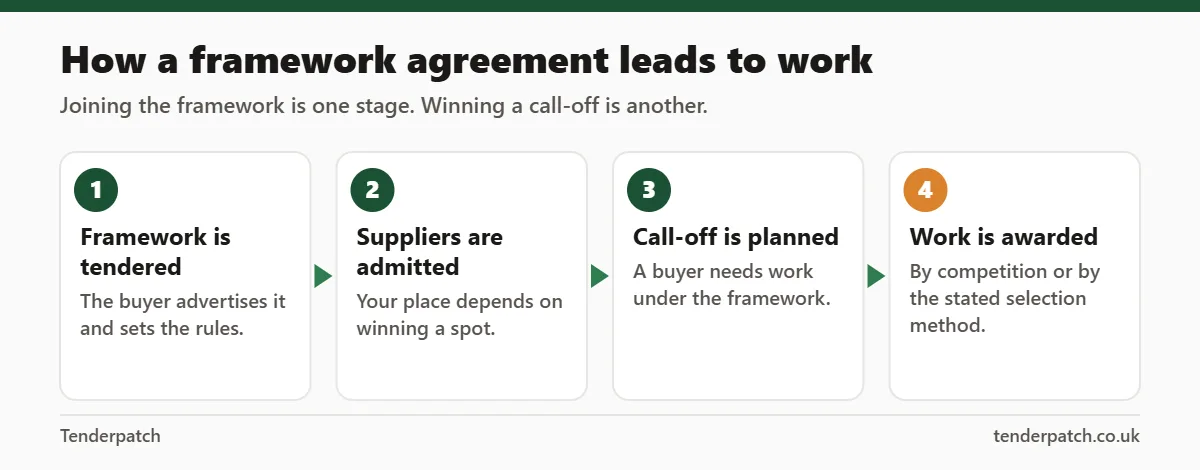
A framework agreement is a contract between a public buyer and one or more suppliers that sets up how future contracts will be awarded. The individual contracts awarded under it are called call-offs. For a small contractor, the key point is that joining a framework agreement is not the same as winning work, and many frameworks need a separate bid or selection for each call-off.
Checked against official guidance on 23 October 2026. Tenderpatch is not a legal adviser: always rely on the official notice and documents before you bid.
In this guide
What a framework agreement is
The Cabinet Office’s guidance on frameworks defines a framework as a contract between a contracting authority and one or more suppliers that sets up future contract awards. Buyers use them to save repeating a full procurement for each purchase, and organisations such as Crown Commercial Service run frameworks that many public bodies can use.
A framework agreement does not normally commit the buyer to place any work. The guidance says a framework will not commit a contracting authority to enter into a call-off contract, although some frameworks might. So read the terms to see what is promised.
Key rules under the Procurement Act
| Point | What the guidance says |
|---|---|
| Maximum term | Generally four years for most frameworks and eight years for defence and security or utilities frameworks, unless the nature of the work justifies longer and the reason is published |
| Call-offs | Contracts awarded under a framework may run beyond the framework’s own term |
| Fees | A buyer may charge a fee only to suppliers awarded a call-off, as a fixed percentage of its estimated value, not for access to the framework |
| Exclusions | Excluded suppliers can be excluded from selection |
These points come from the guidance published for the Procurement Act 2023. Frameworks set up under earlier rules may follow the older arrangements, so check the notice and documents.
Open frameworks
An open framework is a scheme of frameworks that provides for successive frameworks on substantially the same terms. It is designed so new suppliers can join. The guidance says an open framework must be reopened at least once in its first three years and at least every five years after that, with a total life of up to eight years. New suppliers can be added when it reopens, and reopening can happen more often.
That matters because a closed framework can shut small suppliers out for years. If a framework you want is open, note when it will reopen and prepare in advance.
Looking for a simpler way to follow frameworks and tenders relevant to your trade? Start your 14-day free trial. No card is needed and nothing is charged automatically.
How call-offs are awarded
When a buyer needs something, it awards a call-off in one of two ways, depending on how the framework is written:
- With competition. The framework’s suppliers are invited to bid, following the process in the framework.
- Without competition. The buyer awards using an objective selection mechanism set out in the framework, such as a rotation (sometimes called taxi-rank) or highest-ranking supplier system. This is allowed only where the framework sets the mechanism and the core terms.
Call-offs are normally exempt from the mandatory standstill period, because the framework already set the terms. See the standstill guidance.
What a framework agreement means for small contractors
A framework agreement can be a useful route to repeat work, particularly for contractors who deliver the same service regularly. It also has costs: you may need to bid once to join and again for each call-off, comply with the buyer’s processes and pay any fee that applies.
- Advantage: a shorter route to each contract once you are on the framework.
- Advantage: a list of public buyers who can use the framework.
- Risk: no guarantee of any work.
- Risk: a framework may favour larger suppliers or national coverage. Check whether it is split into lots by region or service.
You can search for frameworks on Find a Tender, which includes a Commercial tools section covering framework agreements, dynamic markets and dynamic purchasing systems for procurements published from February 2025.
What to check before you apply
- Are you admitted by lot, and does the lot match your trade and area?
- What will be the call-off process, and how often is it competed?
- What fees, if any, apply, and how are they charged?
- How long is the framework and when will it be reopened?
- What are the buyer’s requirements for insurance, health and safety and evidence?
- Can you take on the volume of work it implies, or is it too large for your capacity?
A scenario: a small landscaper and a regional framework
Imagine a landscaper who does planting and soft landscape maintenance for housing providers in one region. A regional framework is advertised for grounds and landscape works, divided into lots by area and by value. The landscaper reads the notice and the framework documents and asks four questions.
- Which lot fits? A small-value lot in the home region matches its work. A national lot would stretch it.
- How are call-offs awarded? If call-offs go by further competition, the landscaper must be ready to price and write quickly. If they go by a stated rotation, it needs capacity to take work when it is offered.
- What does it cost? A fee, if any, can be charged only on call-offs it wins, as a fixed percentage of their estimated value, so it builds this into its prices.
- When does the framework reopen? If it is an open framework, the landscaper notes the reopening dates, because they are its next chance if it misses this round.
The scenario is hypothetical, but the questions are the useful part: they turn a vague opportunity into a decision. Treat the framework as a way of getting invited to bid, and judge it by how likely the call-offs are to be work you can price and deliver profitably.
Frequently asked questions
What is a framework agreement?
A framework agreement is a contract between a buyer and one or more suppliers that sets up how future contracts, called call-offs, will be awarded.
Does a framework agreement guarantee work?
Not generally. A framework will not commit a buyer to place a call-off, though some frameworks might. Read the terms.
How long can a framework agreement last?
Generally four years, or eight years for defence and security or utilities frameworks, unless the nature of the work justifies longer. Open frameworks work differently, with a total life of up to eight years.
Can a small contractor join a framework agreement?
Yes, if it meets the conditions and wins a place when the framework is tendered or reopened. Check the lots, requirements and call-off method.
To find frameworks and live tenders, see where to find UK public sector tenders, and how Tenderpatch works for matching notices to your trade.
Find Relevant UK Tenders with Tenderpatch
Discover public-sector contract opportunities relevant to your business and explore Tenderpatch’s tender-alert service to follow tenders and notices in your area. Start your 14-day free trial and see how it can simplify your tender search. No card is needed and nothing is charged automatically.
This guide is general information, not legal or procurement advice. Rules and thresholds change: check the official notice and current government guidance before you bid.